

A holiday home management company in Dubai runs a furnished apartment or villa as a short-term rental for its owner, handling listings, pricing, guests, cleaning, maintenance and the permit paperwork. Offers often look alike, so the useful question is not which company ranks first but which one fits your property. Start by asking whose name the holiday home permit will be in: the answer shapes your control over the property and how easily you can change manager later.
Short-term rentals in Dubai are a licensed activity regulated by DTCM (now Dubai’s Department of Economy and Tourism, DET). The official term for a furnished home let by the night is a holiday home, so owners often search for a holiday home management company even when the service is sold as short-term rental or vacation rental management.
This guide covers what these companies do, the two ways DET lets a unit be registered, the duties that come with a permit, how fees and payouts work and ten checks to run before you sign. Rules are stated as of 20 October 2026, with links to the official sources.
Key Takeaways
- A holiday home management company runs your short-term rental day to day: listings, pricing, guests, cleaning, maintenance and permit paperwork.
- DET has two registration routes: you register as the homeowner, or a licensed operator registers your unit under its own licence.
- Whose name is on the permit shapes your control over the property and any change of manager; your agreement sets where the income goes.
- Every unit needs its own permit, renewed in the 30 days before it expires, plus guest records and Tourism Dirham entries.
- Compare companies with the same ten checks on compliance, money, daily care and the contract, not on rankings.
What a Holiday Home Management Company Does
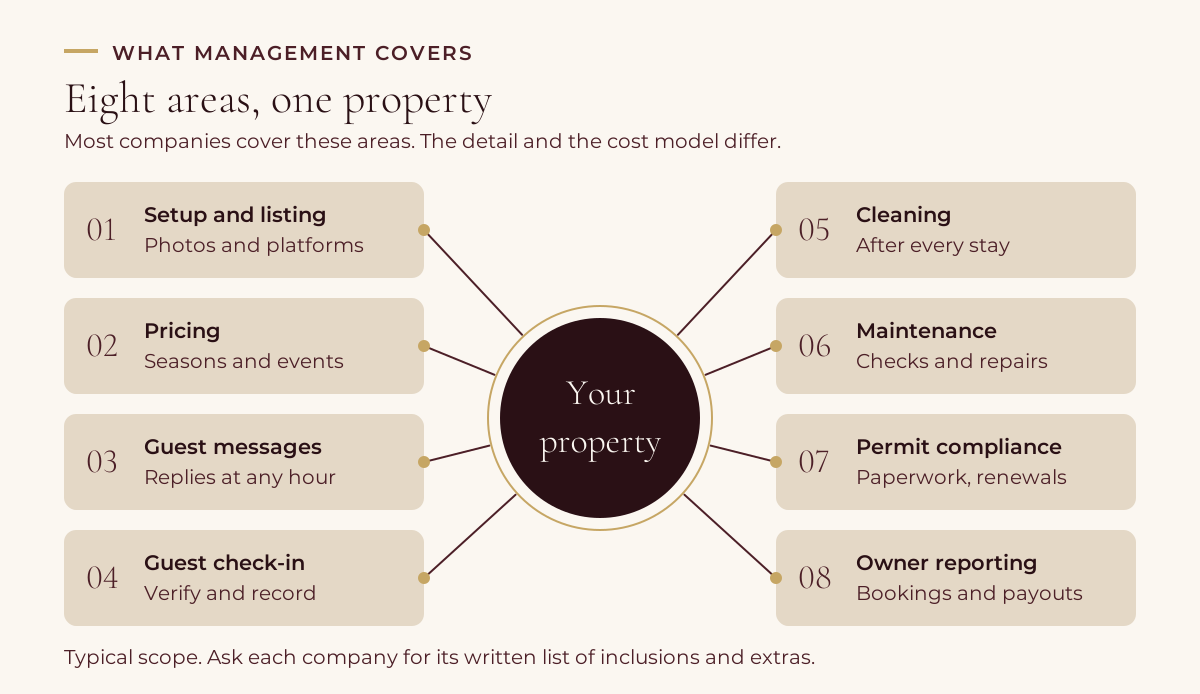
The job is to run the property as a hospitality business on the owner’s behalf. Most companies cover the same core areas, though the detail and the cost model differ.
- Setup and listing: preparing the home, photography and listings on platforms such as Airbnb, Booking.com, Expedia, Agoda and Vrbo.
- Pricing: setting nightly rates and reviewing them for demand, seasons and events.
- Guest communication: answering enquiries and messages at any hour, and handling problems during a stay.
- Check-in and registration: verifying each guest and recording every check-in on DET’s system.
- Cleaning and turnovers: cleaning, linen and restocking after each stay.
- Maintenance and inspections: routine checks, repairs and following up with contractors.
- Permit and compliance: permit paperwork, renewals and Tourism Dirham records.
- Reporting and payouts: statements that show every booking, payout and cost.
To see how these tasks fit together in practice, our pages on holiday home management in Dubai and vacation rental management set them out in more detail.
Homeowner or Licensed Operator: The Two Routes
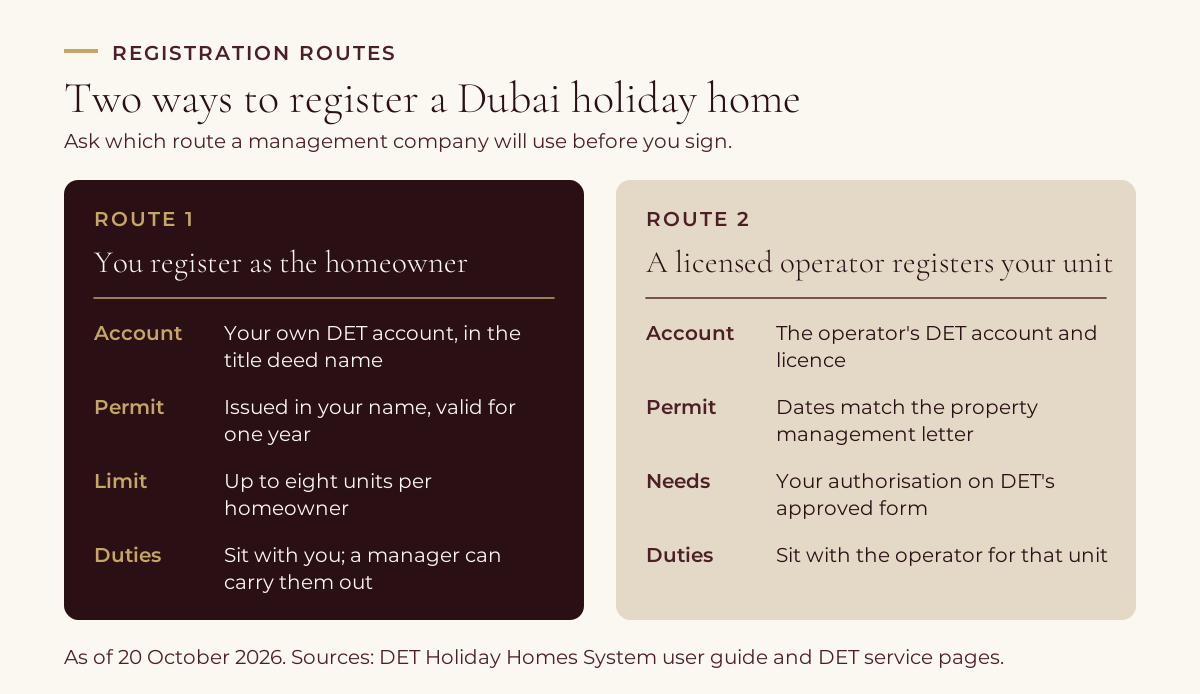
DET’s Holiday Homes system has two account types. According to DET’s Holiday Homes System user guide, you register either as a Home Owner, for a property you own, or as an Operator, meaning a company or establishment with a valid licence. As of 20 October 2026, each route works like this.
Route 1: You Register as the Homeowner
You open an account in your own name, and the name on the account must match the name on the title deed, as DET’s registration requirements state. Individual owners can apply for permits only for units they own, and DET limits homeowners to eight holiday home units. The permit is issued in your name. You can still hire a company to run the daily operations. The company works for you, and the unit stays in your account.
Route 2: A Licensed Operator Registers Your Unit
A company whose trade licence lists the vacation homes rental activity adds your unit to its own account, using your authorisation on DET’s approved form. DET’s permit renewal rules require an operator’s permit dates to match the dates of the property management letter between you and the operator. The operator holds the licence and carries the licensee duties for that unit.
Neither route is wrong, and they suit different owners. What matters is knowing which one a company proposes before you sign, because the answer decides who controls the permit and who carries the licensee duties. It also leads to a third question: where the money goes.
Why the Permit Route Matters to You
Control of the permit. On the homeowner route, the unit sits in your own DET account, so the permit, its renewal dates and its guest records stay with you if you change who runs the operations. On the operator route, the permit is tied to the operator’s licence and to the management letter. Ask what happens to the permit, the listing and future bookings if that arrangement ends early.
Who carries the duties. The licensee duties covered below sit with the party DET registers for the unit. On the homeowner route that is you, which is why many owners hand the daily work to a manager who carries out those tasks and reports back.
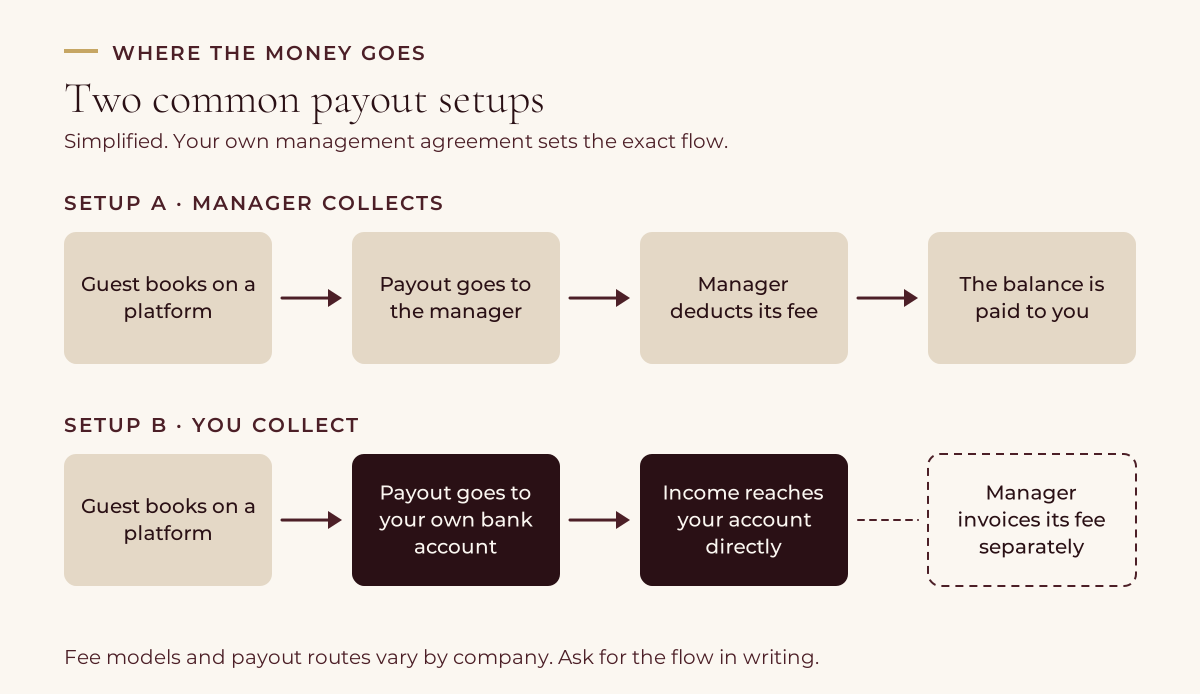
Where the money goes. This is set by your management agreement rather than the permit, so ask where platform payouts land first. In some setups, booking income goes to the manager, who deducts a fee and passes on the balance. In others, it goes straight to the owner’s bank account and the manager invoices its fee separately.
With Prospera, an owner-first holiday home management company in Dubai, the holiday home permit is issued in your name. We prepare the permit paperwork with you, track renewals and verify every guest.
The Permit Year at a Glance
As of 20 October 2026, DET requires every unit to be registered and approved before it is listed. Under Administrative Resolution No. (1) of 2020, the sale and purchase agreement must not contain a clause that rules out holiday home use. DET’s renewal rules add that holiday homes are not permitted in hotel or hotel apartment buildings, and that a no objection certificate from the developer may be needed.
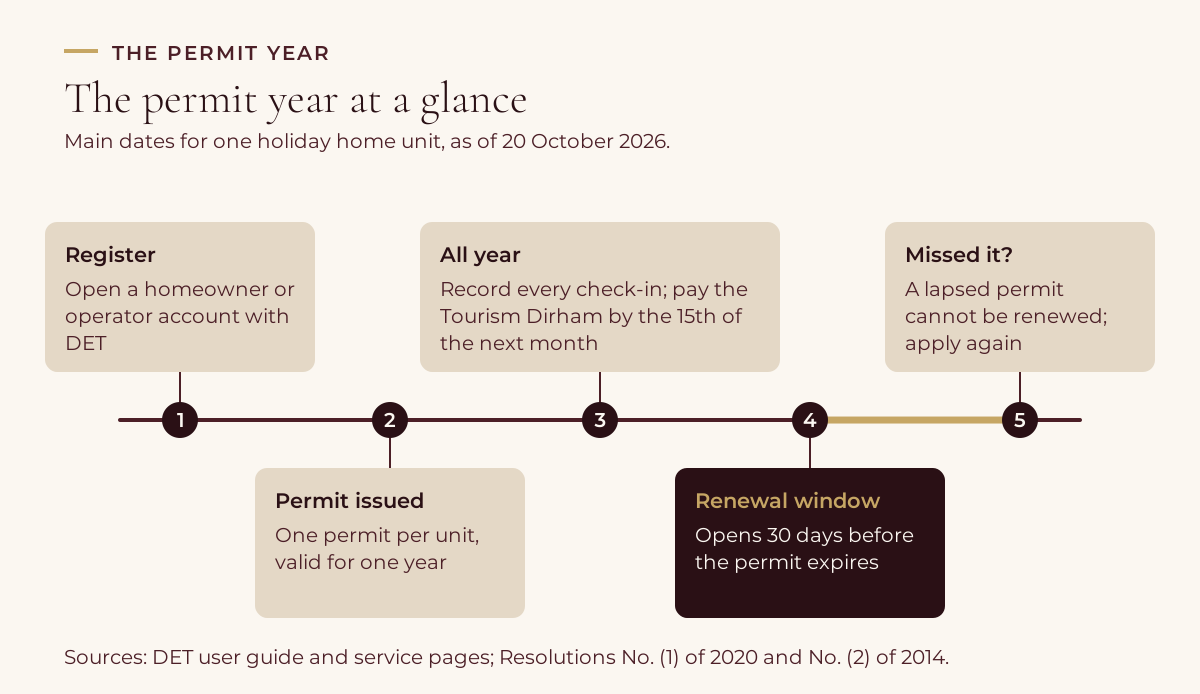
Under the same resolution, a permit is valid for one year and can be renewed. DET’s user guide explains that the renewal option opens only in the 30 days before expiry. If the permit is not renewed in that window, it expires and cannot be renewed, so the unit needs a new application.
The same guide explains that guest check-ins are recorded on DET’s Holiday Home 2.0 system. The Tourism Dirham is charged to guests for each occupied room per night, and the licensee collects it and pays it to DET. As of 20 October 2026, DET lists AED 10 for a Standard holiday home and AED 15 for a Deluxe one. Under Executive Council Resolution No. (2) of 2014, each month’s collections are due by the 15th of the following month, and DET applies late fees after that date.
Fee exemptions were announced in 2026. On 21 May 2026, the Dubai Media Office announced an economic incentives package that includes exemptions from Tourism Dirham collection and from holiday home permit and licence fees for establishments registered with DET. Its measures run for three to 12 months on timelines set by each government entity, and DET can confirm whether and when the exemption applies to your unit. Requirements change, so check the current rules with DET before applying.
Duties That Come With a Permit
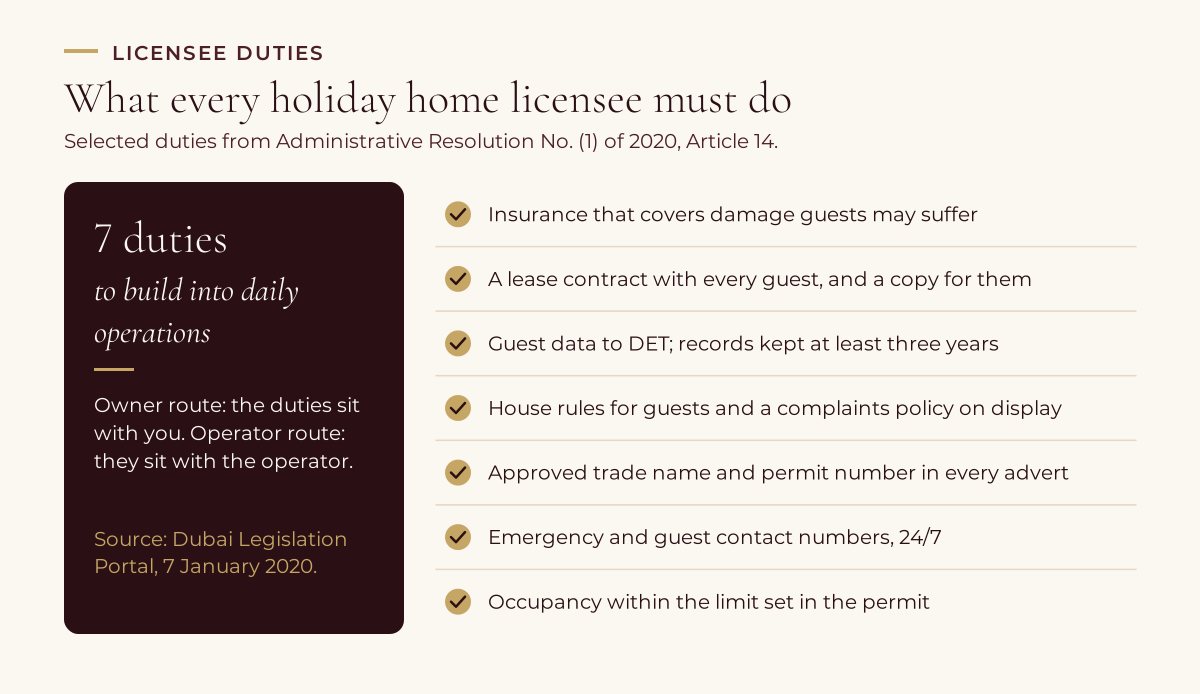
As of 20 October 2026, Administrative Resolution No. (1) of 2020 lists 23 duties for every licensee, whether the registered party is an owner or an operator. Seven of them shape daily operations, and a well-run management company builds them into its routine:
- Hold a comprehensive insurance policy that covers damage guests may suffer.
- Sign a holiday home lease contract with each guest and give them a copy.
- Supply guest information to DET regularly and keep guest records for at least three years.
- Give guests a list of house rules and display a policy for handling complaints.
- Include the licensee’s approved trade name and the permit number in every print and digital advert.
- Keep emergency and guest service numbers available 24 hours a day, seven days a week.
- Stay within the maximum occupancy set in the permit.
When you compare companies, ask how each duty is handled, who does it and how you will see that it was done.
How Management Fees and Payouts Work
Management fees in Dubai usually follow one of two models: a percentage of each booking, or a fixed monthly fee agreed in advance. A percentage rises and falls with your income. A flat fee stays the same, so a strong month leaves more with you and a quiet month carries the same cost. Our guide to how management fees compare in Dubai works through both models with an example.
Government charges usually sit outside a manager’s fee, and so do the booking platforms’ own commissions. Ask for a written list of what the fee includes and what is charged as extra, such as cleaning, linen, guest supplies and repairs.
Prospera charges one flat monthly fee with no revenue share, set by property type. Your rental income goes to your bank account after every booking, and our fee is invoiced separately.
Plan for Busy and Quiet Months
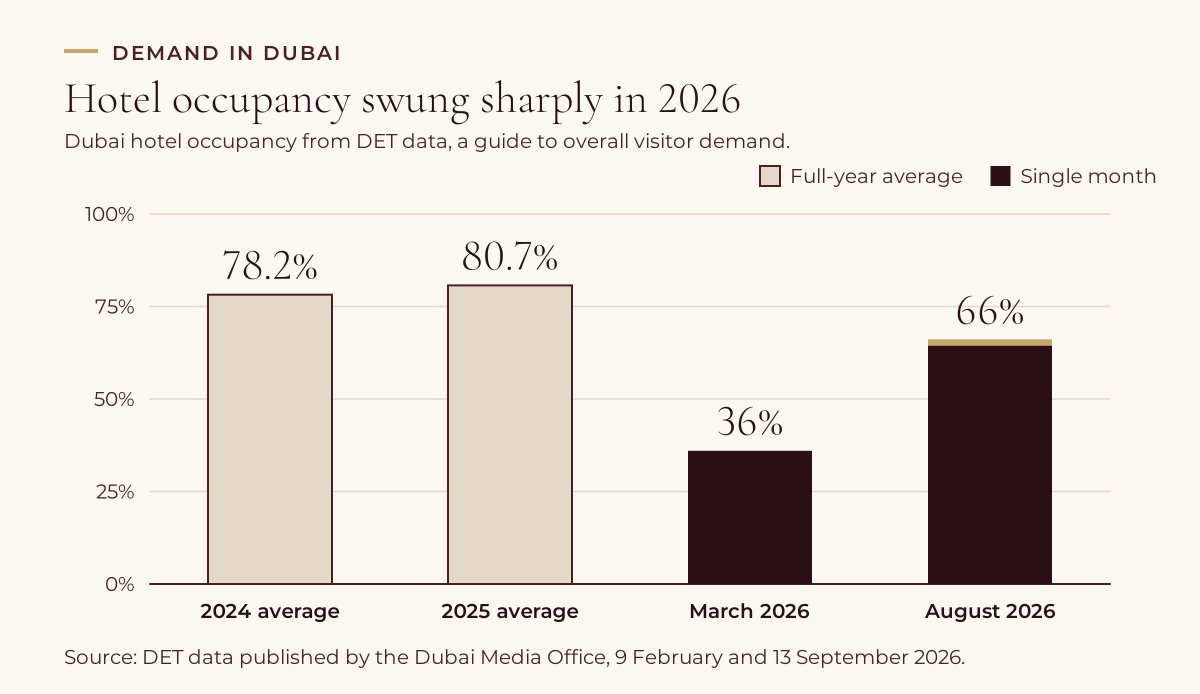
Demand for short stays in Dubai moves with the seasons and with events, and 2026 showed how quickly it can change. DET data published by the Dubai Media Office shows the city welcomed 19.59 million international overnight visitors in 2025, up 5% on 2024, with average hotel occupancy of 80.7%.
In 2026, after a regional situation disrupted travel early in the year, hotel occupancy was 36% in March, then recovered to 66% in August, according to DET figures published by the Dubai Media Office on 13 September 2026. Dubai welcomed 6.97 million international overnight visitors from January to August 2026.
These are hotel figures rather than holiday home figures, but they show the pattern a manager has to price for. Ask how often rates are reviewed, how the calendar is filled in quiet weeks and how the fee model behaves when bookings slow.
Ten Checks Before You Sign
A list naming the best holiday home management company in Dubai cannot tell you which company suits your property. The right choice depends on how you want to be paid, how involved you want to be and how much you want to see. Run these ten checks with every company you speak to.
Compliance and Trust
1. The permit and DET registration. Ask which DET route the company uses, who prepares the permit paperwork, whose name the permit is in and who tracks renewals.
2. Guest verification. Guest details must be registered for every stay. Ask how the company checks guests before arrival and what it does if house rules are broken.
3. Reviews from owners. Ask to speak to current owners or read their reviews, and look for specific comments on communication, payments and property care.
Money and Transparency
4. The fee model. Is it a share of each booking or a flat monthly fee? Ask what is included and what is charged as extra, and get both in writing.
5. How and when you get paid. Ask where the booking money goes first and how long it takes to reach you.
6. Reporting and access. You should see every booking, payout and cost. Ask for a sample report and whether you get a live owner dashboard.
Operations and Care
7. Guest communication. Ask who answers guests late at night or on public holidays, because slow replies lead to poor reviews.
8. Cleaning, maintenance and spending limits. Ask who does the cleaning and repairs, how quality is checked and what spending limit applies before the company needs your approval. Our page on property care, maintenance and inspections shows what this looks like day to day.
9. Pricing and channels. Ask how nightly rates are set and how often they are reviewed, which booking platforms will list your property and whether the calendars stay in sync.
The Contract
10. Contract length and exit terms. Check the length, renewal, notice period and what happens on exit: future bookings, the listing, keys and guest records. Our guide to the management agreement covers the clauses to read before you sign.
Quick Comparison Checklist
| Check | Question to ask | Good sign |
|---|---|---|
| 1. DET compliance | Who handles the permit and renewals? | A clear answer, in writing |
| 2. Guest verification | How are guests registered? | Every guest checked before arrival |
| 3. Owner reviews | Can I speak to current owners? | Specific, recent feedback |
| 4. Fee model | How is the fee calculated? | Written terms, no hidden percentages |
| 5. Payouts | When does my income reach me? | Paid to your own account, quickly |
| 6. Reporting | What will I see? | A live dashboard and monthly statements |
| 7. Guest care | Who answers guests at night? | A team available 24/7 |
| 8. Maintenance | What is the spending limit? | Your approval before larger costs |
| 9. Pricing | How often are rates reviewed? | Regular reviews based on demand |
| 10. Contract | How do I exit? | A clear notice period and handover |
Start With the Permit Question
A holiday home management company can take the daily work of a Dubai short-term rental off your hands. The setup underneath matters as much as the service list: who holds the permit, where the income goes and how you can leave. Get those answers in writing and the rest of the comparison becomes simpler.
If you’d like us to look at your apartment or villa and explain the permit steps and running costs, book a free rental assessment.
Frequently Asked Questions
What does a holiday home management company in Dubai do?
It runs a furnished apartment or villa as a short-term rental for the owner. That usually covers listings, nightly pricing, guest messages, check-ins, cleaning, maintenance, permit paperwork and owner reporting.
Do I need a permit to rent my Dubai property as a holiday home?
Yes. As of 20 October 2026, every unit must be registered and approved by DET, formerly DTCM, before it is listed. Each permit is valid for one year and must be renewed in the 30 days before it expires.
Can a management company hold the holiday home permit for me?
A company licensed by DET as a holiday home operator can register your unit under its own licence, with your authorisation and a property management letter. Alternatively, you register as the homeowner, the permit is issued in your name and a manager runs the daily work. Ask each company which route it uses.
Whose name should the holiday home permit be in?
It depends on how much control you want. A permit in your own name keeps the unit, its renewals and its guest records in your account on DET’s system, even if you change who runs the operations. If an operator holds it, ask what happens to the permit and future bookings when the agreement ends.
How many holiday homes can an individual owner register in Dubai?
As of 20 October 2026, DET states that homeowners can register up to eight holiday home units. Owners can apply for permits only for units they own, and the name on the account must match the title deed.
What is the Tourism Dirham for holiday homes?
It is charged to guests for each occupied room per night, and the licensee pays it to DET. As of 20 October 2026, DET lists AED 10 for a Standard holiday home and AED 15 for a Deluxe one, due by the 15th of the following month. An economic incentives package announced on 21 May 2026 includes an exemption from Tourism Dirham collection for establishments registered with DET, so check the current position with DET.
What questions should I ask a holiday home management company?
Ask which DET route it uses and whose name the permit will be in, how guests are verified, how the fee is calculated, when your income is paid, what reports you will see, who answers guests at night, what the repair spending limit is and how you can exit.
How do holiday home management companies charge?
Most use one of two models: a percentage of each booking, or a flat monthly fee agreed in advance. Compare the yearly total, what is included, what is charged as extra and where your rental income is paid.
Which is the best holiday home management company in Dubai?
There is no single best company for every owner. Compare companies on who holds the permit, how guests are registered, the fee model, payout timing, reporting and exit terms, and choose the one that fits your property and goals.
Can I switch holiday home management companies?
Usually yes, subject to the notice period in your agreement. Before you sign, check how the permit, listings, future bookings, keys and guest records are handed over if you leave.
This article is general information, not legal or financial advice.
Sources
- Dubai Department of Economy and Tourism (DET), Holiday Homes System User Guide, accessed 20 October 2026
- DET, Register to operate Holiday Homes, accessed 20 October 2026
- DET, Renew a Holiday Homes permit, accessed 20 October 2026
- DET, Hospitality services and permits, accessed 20 October 2026
- Dubai Legislation Portal, Administrative Resolution No. (1) of 2020 Issuing the Implementing Bylaw of Decree No. (41) of 2013, issued 7 January 2020
- Dubai Legislation Portal, Executive Council Resolution No. (2) of 2014 Approving the Tourism Dirham Fee, issued 24 January 2014
- Government of Dubai Media Office, Hamdan bin Mohammed approves second, larger AED1.5 billion economic incentives package, 21 May 2026
- Government of Dubai Media Office (DET data), Dubai’s tourism industry achieves third successive record-breaking year, 9 February 2026
- Government of Dubai Media Office (DET data), Dubai’s tourism sector records highest visitor numbers since February as ATM 2026 opens, 13 September 2026