

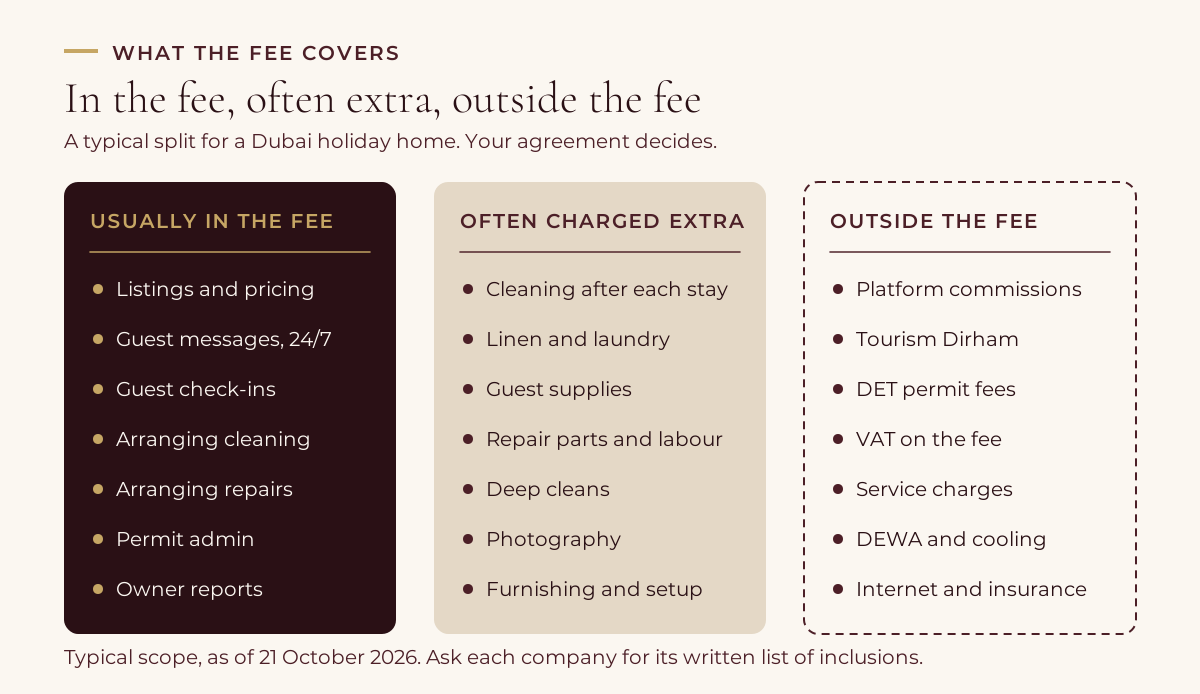
A holiday home management fee in Dubai usually pays for the work of running your short-term rental: listings and nightly pricing, guest messages and check-ins, and arranging cleaners and repairs. The materials and services behind that work, such as the cleaning itself, laundry, guest supplies and repair parts, are often billed on top. Booking platform commissions and government charges sit outside the fee altogether.
Holiday homes in Dubai must be registered and approved by DTCM (now Dubai’s Department of Economy and Tourism, DET) before they are listed, and some charges, such as the Tourism Dirham, belong to the permit rather than to the manager. That is why two quotes with the same headline rate can leave you with very different amounts each month.
This guide goes line by line through what the fee usually covers, what is charged per stay, what a percentage fee is worked out on, one-off setup costs and the costs that stay with you. For how a revenue share compares with a flat monthly fee, see our guide to revenue share versus a flat fee. Platform and government charges are stated as of 21 October 2026, with links to the official sources.
Key Takeaways
- The management fee usually pays for work: listings, pricing, guest messages, check-ins and arranging cleaning and repairs.
- Cleaning, laundry, guest supplies and repair parts are often charged per stay or at cost, on top of the fee.
- Platform commissions, such as Airbnb’s single 15.5% host fee, and government charges such as the Tourism Dirham sit outside the management fee.
- A percentage fee can be worked out on the booking total or on what is left after the platform fee, so ask which.
- Get a written list of inclusions, extras, spending limits and mark-ups before you compare two quotes.
What the Management Fee Usually Covers
The fee pays for the people and systems that run the property day to day. Most companies include these core services, though the detail differs:
- Listings: creating and updating listings on platforms such as Airbnb, Booking.com and Vrbo.
- Pricing: setting nightly rates and adjusting them for seasons, events and demand.
- Guest communication: answering enquiries and messages, and handling problems during a stay.
- Check-in and guest records: verifying guests and recording each stay on DET’s system.
- Coordination: booking cleaners, laundry and contractors, and checking the work.
- Permit admin: keeping the holiday home permit, renewals and Tourism Dirham records in order.
- Reporting: statements that show each booking, payout and cost.
What the fee buys is mostly coordination. The cleaner’s time, the laundry, the shampoo in the bathroom and the part that fixes a leaking tap are usually separate costs. Our page on vacation rental management shows how these services fit together.
Per-Stay Costs: Cleaning, Laundry and Guest Supplies
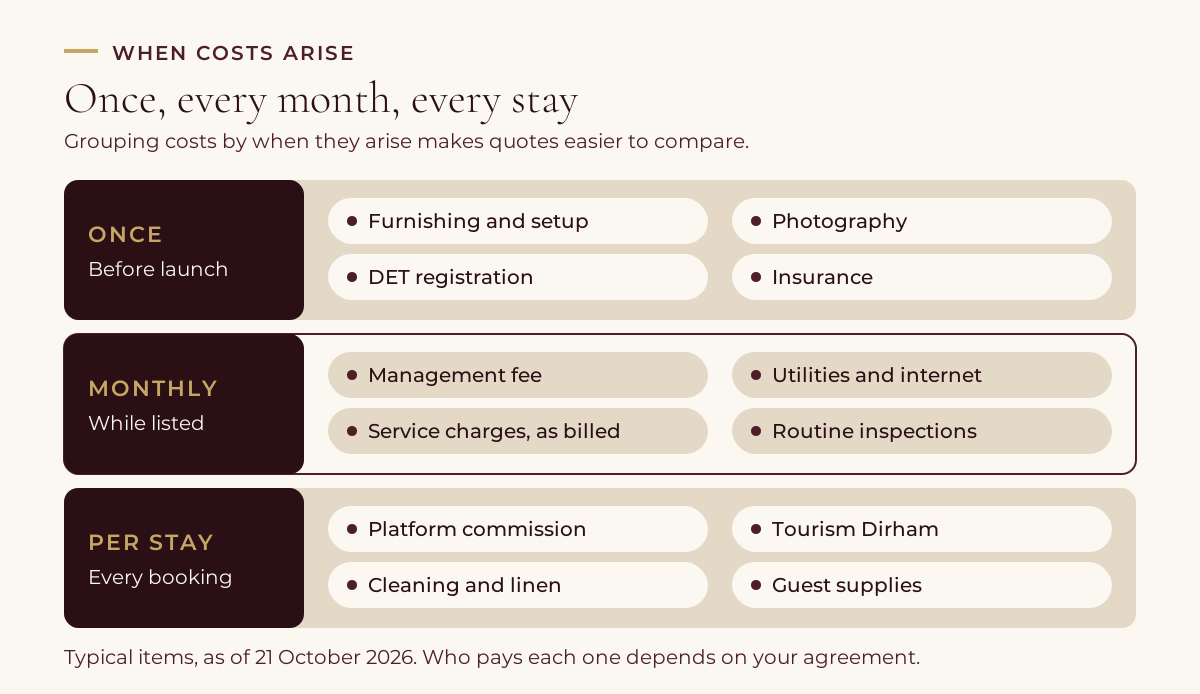
Some costs come round with every booking. Cleaning after checkout, laundry for sheets and towels, and restocking guest supplies such as toiletries, coffee and toilet paper are the main ones. Companies bill them in one of three ways: inside the fee, at cost against receipts, or as a fixed amount per stay.
Linen needs its own questions. Ask who buys the first sets, who pays to replace stained or worn items, and who owns the linen if you change manager. Ask the same about guest supplies: whether they are bought at cost or billed as a fixed pack, and who chooses the brands.
Who Keeps the Guest Cleaning Fee?
Booking platforms let hosts add a cleaning fee to each reservation. On Airbnb it is a flat fee per booking, set in the listing’s pricing settings and included in the total price guests see. Ask three questions: does the guest’s cleaning fee go to you, to the manager or straight to the cleaner; does it cover the full cost of each clean; and is a management percentage also taken from it?
Platforms charge their own fees on it too. Booking.com charges its commission on the total booking amount, including additional fees such as cleaning, and Vrbo’s 12% commission applies to the rent and to host fees such as cleaning.
What a Percentage Fee Is Worked Out On
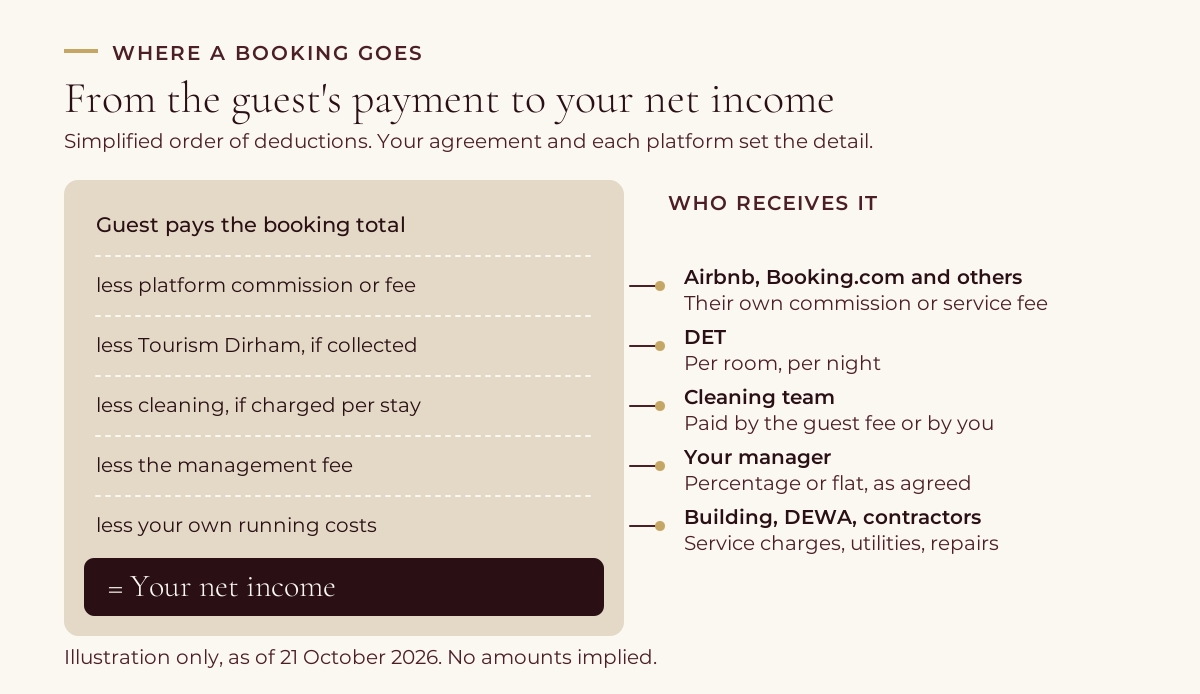
A percentage fee sounds simple until you ask what it is a percentage of. A booking breaks into several parts: the nightly rate, any cleaning fee, the platform’s commission or service fee, the Tourism Dirham and, where it applies, VAT. Some managers take their share from the full amount the guest pays. Others take it after the platform fee, or from the nightly rate only.
On a flat monthly fee, this question falls away, because the fee does not move with the value of each booking. On a percentage, ask for a worked example of one real booking, from the guest’s payment down to your payout, before you sign.
Booking Platform Commissions Sit Outside the Fee
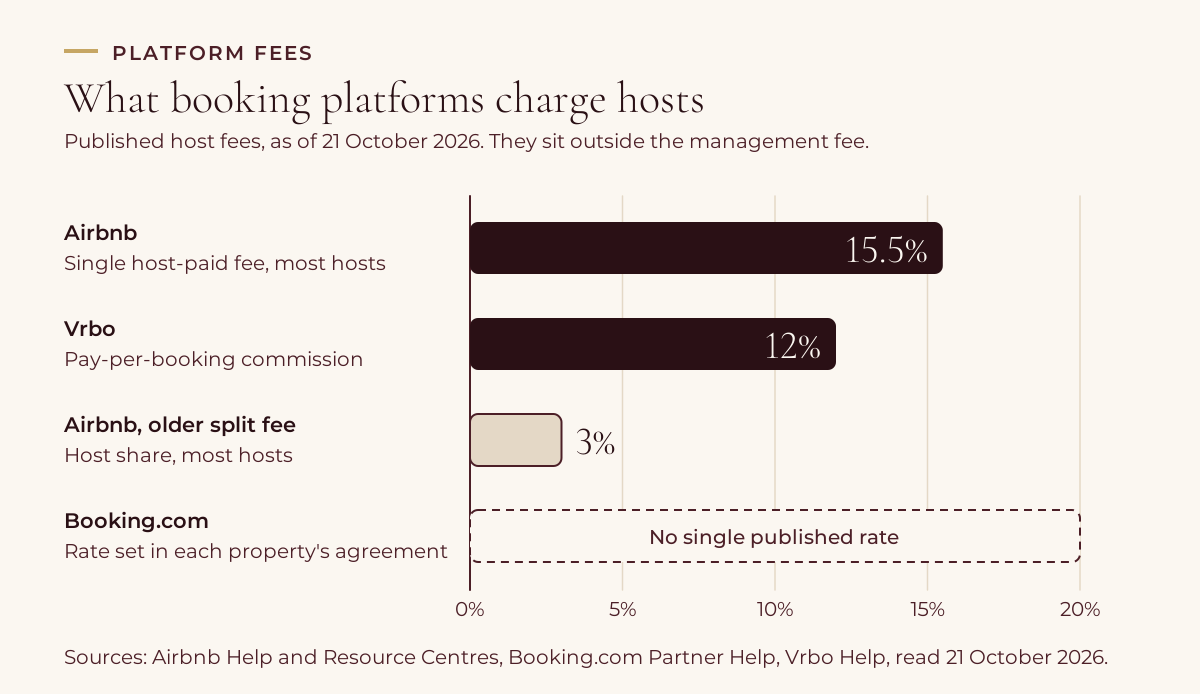
The platform’s own charge is usually the largest deduction from a booking, and it is not part of the management fee. Airbnb is moving all home hosts to a single service fee paid by the host, deducted from the payout. Its October 2026 update puts that fee at 15.5% for most hosts. Under the older split fee, most hosts paid 3% and guests paid a separate service fee on top.
Booking.com does not publish one rate: its commission depends on the country, the property type and the agreement the property signed. Vrbo charges a flat 12% per booking, which includes payment processing. Whichever platforms list your home, ask whether the manager’s percentage is taken before or after these fees.
Repairs and Maintenance: Limits, Call-Outs and Mark-Ups
Most agreements treat the manager’s time as part of the fee and the repair itself as an owner cost. Four details decide what you actually pay:
- Spending limit: the amount a manager can spend on a repair without asking you first, plus a rule for emergencies when you cannot be reached.
- Call-out charges: whether a visit to check a fault is charged even when nothing needs replacing.
- Quotes: how many quotes the manager gets before larger jobs, and whether you see them.
- Mark-ups: whether contractor invoices are passed on at cost or with a supervision fee added. Ask to see the original invoice.
Regular maintenance is also a licence matter: Resolution No. (49) of 2014 lists failing to maintain a holiday home regularly as an offence. Our page on maintenance and inspections shows what routine checks look like day to day.
One-Off Costs Before the First Booking
A holiday home costs money before any income arrives. Common one-off items include furnishing and styling to the standard of the listing, professional photography, the first sets of linen and kitchen equipment, a smart lock or key box, and DET registration. Some companies charge an onboarding fee that covers the listing build and photography; others waive it.
If an onboarding fee is waived, ask whether it is charged back if you leave early, and ask for a written list of what onboarding covers so you can see which setup costs fall to you.
Insurance is another early cost. Under Administrative Resolution No. (1) of 2020, every holiday home licensee must hold a comprehensive insurance policy that covers damage guests may suffer. Check who arranges it, whose name it is in and whether ordinary home contents cover is enough.
Government Charges: Permit Fees, Tourism Dirham and VAT
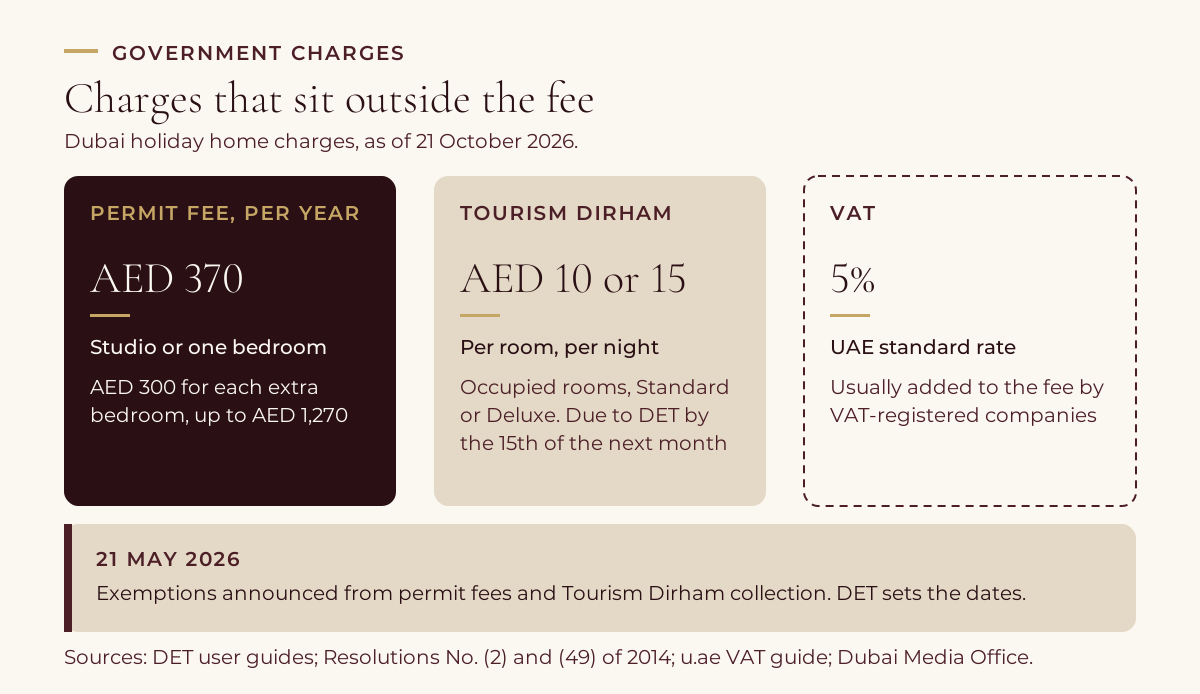
DET charges a fee for each holiday home permit, both on issue and at each yearly renewal. Its Holiday Homes System user guide puts the fee at AED 370 for a studio or one-bedroom unit, with a maximum of AED 1,270 however many bedrooms the unit has. The bedroom part, AED 300 per bedroom up to AED 1,200 a year, is set by Executive Council Resolution No. (49) of 2014. Ask whether a manager pays these fees for you and recharges them, or bills them with onboarding.
The Tourism Dirham is charged to guests for each occupied room per night. As of 21 October 2026, DET’s guide to leasing out holiday homes lists AED 10 per room per night for a Standard holiday home and AED 15 for a Deluxe one, and DET must receive each month’s collections by the 15th of the following month. The rates are set by Executive Council Resolution No. (2) of 2014. Airbnb’s Dubai hosting page states that the host is responsible for collecting it from guests. The money passes through to DET; collecting and reporting it is part of the permit admin most managers handle.
On 21 May 2026, the Dubai Media Office announced an economic incentives package that includes exemptions from Tourism Dirham collection and from holiday home permit and licence fees for establishments registered with DET. Each government entity sets its own timeline, so DET can confirm whether and when the exemptions apply to your unit. Requirements change, so check the current rules with DET before applying.
VAT is a separate line. The UAE’s VAT guide for property applies the standard 5% rate to building services such as maintenance and real-estate agent fees, and treats short lets of six months or less as commercial property. A VAT-registered management company will usually add 5% to its fee, so ask whether a quote includes VAT, and check your own VAT position on short stays with a tax adviser.
Running Costs That Stay With You
Some costs belong to the property, whoever manages it. These usually stay with the owner:
- Service charges: the community or building charges that the Dubai Land Department confirms are the owner’s to pay unless the lease says otherwise.
- Utilities: DEWA electricity and water, district cooling where the building uses it, and gas. Charging guests extra for electricity and water is an offence under Resolution No. (49) of 2014, so these stay a property cost.
- Internet and TV: guests expect fast Wi-Fi, so this is a fixed monthly cost.
- Insurance: the policy that covers guests, plus your own building or contents cover.
- Owner stays: cleaning and laundry after your own visits are usually charged like a guest stay.
Ask whether the manager pays these bills on your behalf and recharges them, or whether they stay in your name. Either works, as long as every recharge appears on your statement.
Fine Print That Changes the Real Cost
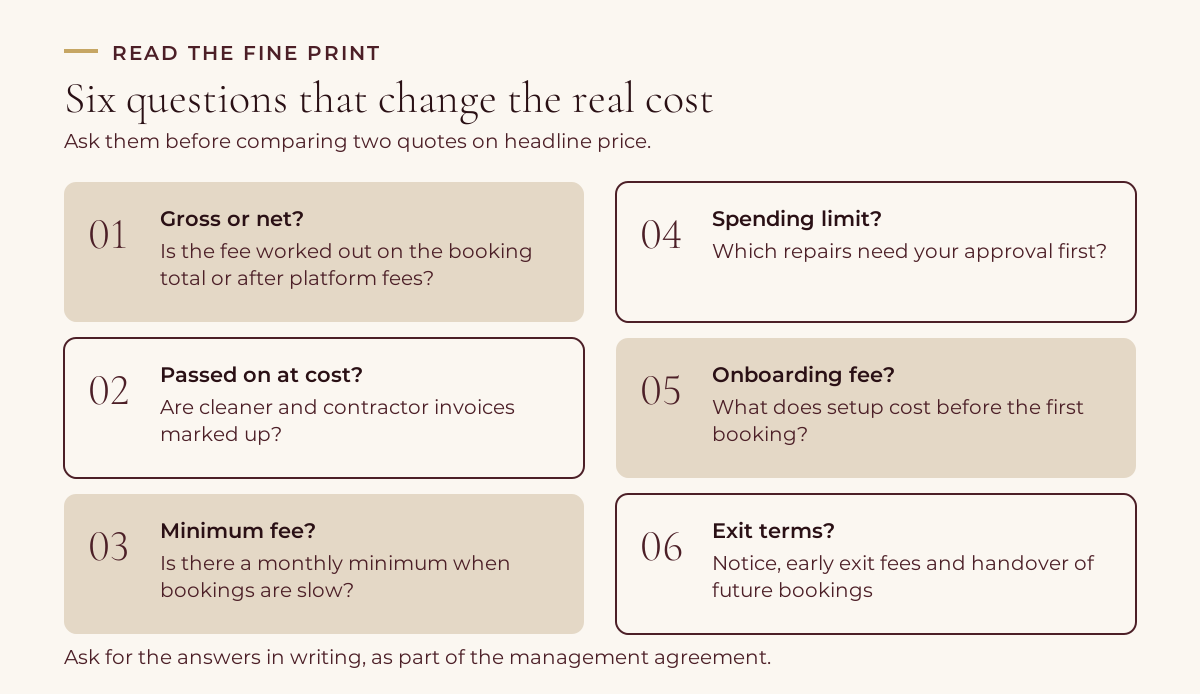
Two quotes can look alike on paper and cost very different amounts. Ask about these terms before comparing headline rates:
- Fee base: whether a percentage is taken from the booking total or after platform fees.
- Mark-ups: whether cleaner and contractor invoices are passed on at cost.
- Minimum fee: whether a monthly minimum applies when bookings are slow.
- Spending limit: which repairs need your approval first.
- Onboarding: what setup costs, and whether a waived fee is charged back on exit.
- Exit terms: the notice period, any early exit fee and what happens to future bookings.
Our guide to the clauses to check in a management agreement covers exit terms and approval limits in more detail, and our ten checks before you sign help you compare companies side by side.
How Our Fee Works
Prospera charges one flat monthly fee with no revenue share, set by property type. Rental income goes to your own bank account after every booking, and our fee, which covers listings, guest management, compliance support and the coordination of housekeeping and maintenance, is invoiced separately.
Quick Inclusion Checklist
| Item | Usually | Question to ask |
|---|---|---|
| Listings and pricing | In the fee | Which platforms, and how often are rates reviewed? |
| Guest messages and check-in | In the fee | Who answers guests at night? |
| Cleaning after each stay | Per stay or guest fee | Who keeps the guest cleaning fee? |
| Linen and laundry | Per stay or at cost | Who replaces worn items? |
| Guest supplies | At cost or fixed pack | Billed at cost or per stay? |
| Repairs | Owner cost | What is the spending limit? |
| Contractor invoices | At cost or marked up | Can I see the original invoice? |
| Platform commission | Outside the fee | Is your fee taken before or after it? |
| Tourism Dirham and permit | Outside the fee | Who collects, files and renews? |
| VAT | Added if registered | Does the quote include VAT? |
Get the Inclusions in Writing
A management fee is easiest to compare when you can see what sits inside it and what is billed around it. Ask each company for a written list of inclusions, per-stay charges, spending limits and pass-through costs, plus a worked example of one booking from the guest’s payment to your payout.
If you’d like us to walk through the costs for your apartment or villa, book a free rental assessment.
Frequently Asked Questions
What does a holiday home management fee cover in Dubai?
It usually covers the work of running the property: listings, nightly pricing, guest messages, check-ins, arranging cleaning and repairs, permit admin and owner reporting. Cleaning, laundry, guest supplies and repair parts are often charged separately.
Who keeps the cleaning fee that guests pay?
It depends on the agreement. The guest’s cleaning fee may go to you, to the manager or to the cleaner, and it may not cover the full cost of each clean. Ask who receives it and whether a management percentage is also taken from it.
Is the management fee taken before or after Airbnb’s commission?
It varies by company. Some take their percentage from the full booking amount, others from what is left after the platform fee. As of 21 October 2026, Airbnb is moving all home hosts to a single host-paid service fee of 15.5% for most hosts, so the difference matters.
Is VAT added to holiday home management fees in Dubai?
Usually, if the company is registered for VAT. The UAE’s standard rate is 5%, so ask whether a quoted fee includes VAT or has it added on top. Your own VAT position on short stays is a separate question for a tax adviser.
Do holiday home management companies charge a setup fee?
Some charge an onboarding fee for the listing build, photography and inventory, and some waive it. If it is waived, ask whether it is charged back if you leave early.
Who pays for linen, towels and toiletries in a holiday home?
Usually the owner, either at cost or as a fixed charge per stay. Ask who buys the first sets, who replaces worn items and who owns the linen if you change manager.
Who pays for repairs in a managed holiday home?
The owner usually pays for parts and contractor work, while the manager’s time arranging the repair is part of the fee. Agree a spending limit above which the manager needs your approval, and a rule for emergencies.
Do property managers add a mark-up to contractor invoices?
Some do, often as a supervision fee. Ask whether invoices are passed on at cost, and ask to see the original invoice for any repair.
Who pays DEWA and internet bills for a holiday home in Dubai?
These stay with the owner whoever manages the property, along with service charges and district cooling. The manager may pay them for you and recharge them, so check that every recharge appears on your statement.
Is there a minimum monthly fee for holiday home management?
Some percentage-based agreements set a monthly minimum that you pay even when bookings are slow. A flat monthly fee stays the same every month. Ask about minimums before you compare quotes.
This article is general information, not legal or financial advice.
Sources
- Dubai Department of Economy and Tourism (DET), Hospitality services and permits, accessed 21 October 2026
- DET, Holiday Homes System User Guide, accessed 21 October 2026
- DET, Leasing Out Holiday Homes User Guide, accessed 21 October 2026
- Dubai Legislation Portal, Executive Council Resolution No. (49) of 2014 Approving the Fees and Fines Related to the Activity of Leasing out Holiday Homes, issued 7 December 2014
- Dubai Legislation Portal, Executive Council Resolution No. (2) of 2014 Approving the Tourism Dirham Fee, issued 24 January 2014
- Dubai Legislation Portal, Administrative Resolution No. (1) of 2020 Issuing the Implementing Bylaw of Decree No. (41) of 2013, issued 7 January 2020
- Government of Dubai Media Office, Hamdan bin Mohammed approves second, larger AED1.5 billion economic incentives package, 21 May 2026
- Airbnb Help Center, Airbnb service fees, accessed 21 October 2026
- Airbnb Resource Center, Simplifying Airbnb service fees, updated 13 October 2026
- Airbnb Help Center, Add additional fees to home listings, accessed 21 October 2026
- Airbnb Help Center, Responsible hosting in Dubai, accessed 21 October 2026
- UAE Government portal (u.ae), VAT treatment of properties, accessed 21 October 2026
- Dubai Land Department, Real estate property owner is obliged to pay service and usage charges for jointly owned property, 6 January 2020
- Booking.com Partner Help, Understanding your commission, accessed 21 October 2026
- Vrbo Help, About the pay-per-booking (PPB) model, accessed 21 October 2026