

Rental yield in Dubai is the number most investors ask about first, and the one most often quoted without context. A holiday home and an annual lease can show very different yields on the same apartment, and the gap changes with the season, the year and the costs you include. 2026 tested that gap harder than any year in recent memory.
This guide explains gross and net yield, sets out the latest figures for one-bedroom homes and shows how to compare a holiday home with an annual lease on your own numbers.
Key Takeaways
- Gross yield is annual rent divided by the property price; net yield subtracts running costs first.
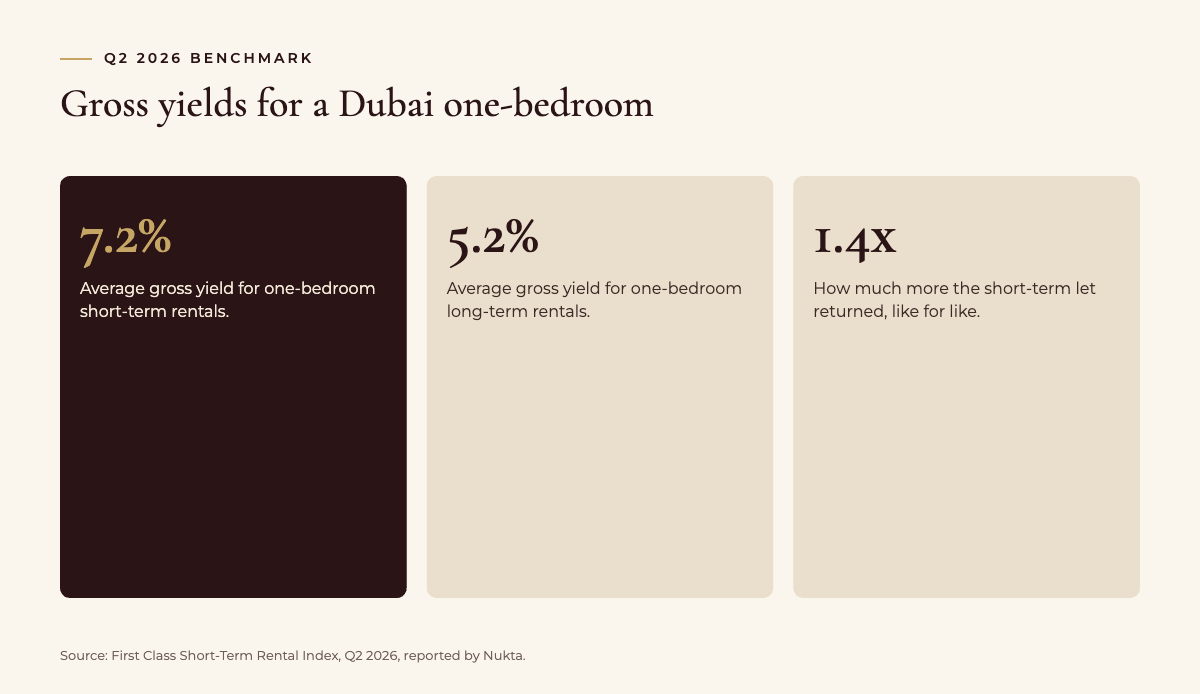
- In the second quarter of 2026, one-bedroom holiday homes earned an average gross yield of 7.2%, against 5.2% for long lets.
- Holiday homes carry higher running costs: utilities, cleaning, linen, furnishing and management.
- The gap narrowed in 2026 as short-term rental revenue fell, but it did not close.
- Compare net yields on a realistic year, including quiet months.
Gross yield and net yield
Gross yield is the simplest measure. Divide a year’s rental income by the price of the property and multiply by 100. An apartment bought for AED 1,000,000 that earns AED 60,000 a year has a gross yield of 6%.
Net yield subtracts the costs of earning that income: service charges, utilities, cleaning, maintenance, management and any empty periods. It is the figure that matters to your bank balance, and it is where holiday homes and annual leases differ most.
What the 2026 numbers show
The First Class Short-Term Rental Index, reported by Nukta, found that one-bedroom short-term rentals produced an average gross yield of 7.2% in the second quarter of 2026, compared with 5.2% for long-term rentals. That made the short-term let about 1.4 times as profitable on a like-for-like gross basis.
The same quarter was one of the toughest on record for holiday homes. RevPAR fell 46.5% year on year after the regional disruption in March, occupancy dropped to 47.7% and the average daily rate fell 17.9% to AED 373. A yield lead that survives a quarter like that is meaningful, but it is smaller than in a strong year.
The costs that close the gap
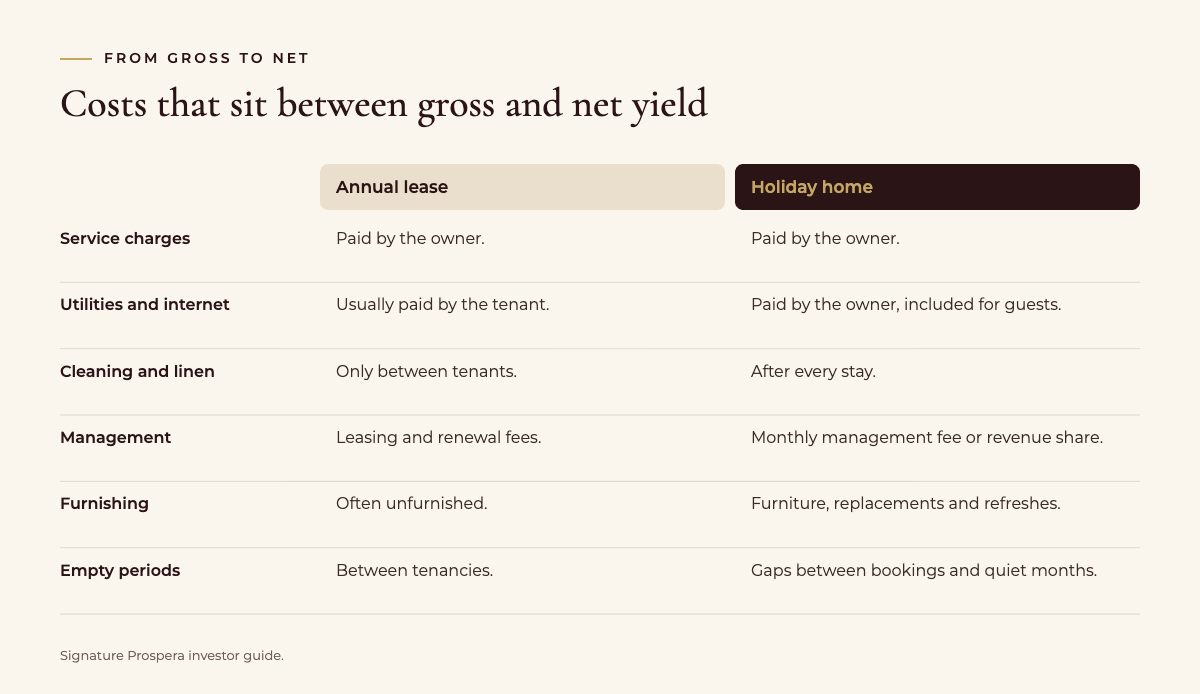
A holiday home earns more rent, and it also costs more to run. Before you compare, list the costs each model carries.
- Utilities and internet. Tenants usually pay these on a long lease; a holiday home owner pays them for guests.
- Cleaning and linen. A long let needs a clean between tenants; a holiday home needs one after every stay.
- Furnishing. Holiday homes need full furniture and regular refreshes as items wear.
- Management. Long-let managers charge leasing and renewal fees; holiday home managers charge a monthly fee or a revenue share.
- Empty periods. A long let may sit empty between tenants; a holiday home has gaps between bookings and quiet months.
Our guide to the hidden costs of running a holiday home in Dubai goes through each line.

How to compare on your own numbers
- Estimate a realistic annual rent for an annual lease, using current listings in your building.
- Estimate holiday home revenue for a full year, including quiet months, not only December.
- List the running costs for each model.
- Subtract the costs from the rent to get net income for each.
- Divide each net income by the property price to get net yield.
Test the holiday home figure on a weak year as well as a strong one. If the holiday home still wins on a cautious estimate, the case is solid. If it only wins at peak rates, the annual lease may suit you better.
Which one suits you
An annual lease suits owners who want steady income, minimal involvement and one tenant for a year or more. A holiday home suits owners who want higher potential income, the option to use the home themselves and the flexibility to switch between short, weekly and monthly stays. In 2026, holiday homes that could serve monthly guests in quiet months held up most strongly.
If you are still choosing, our comparison of short-term and long-term rental in Dubai covers the non-financial trade-offs too.
How Signature Prospera helps
We prepare a pricing report based on data for your home before you decide, so you can compare the two models on real figures. Our management fee is one fixed amount by property type, with no revenue share, which keeps the cost side of your net yield predictable. See our property management in Dubai service.
More Airbnb Management Guides
Frequently Asked Questions
What is a good rental yield in Dubai?
It depends on the area, the property and whether you let it short or long term. In the second quarter of 2026, one-bedroom homes averaged 7.2% gross as holiday homes and 5.2% gross on long leases.
Is gross yield or net yield more important?
Net yield matters more, because it subtracts the costs of earning the rent. Holiday homes and annual leases have very different costs.
Do holiday homes earn more than annual leases in Dubai?
On a gross basis, one-bedroom holiday homes earned about 1.4 times as much as long lets in the second quarter of 2026. Higher running costs narrow that lead on a net basis.
How do I calculate rental yield?
Divide the annual rental income by the property price and multiply by 100 for gross yield. Subtract annual running costs from the income first to get net yield.
Did rental yields fall in 2026?
Short-term rental income fell sharply in the spring, with RevPAR down 46.5% year on year in the second quarter. One-bedroom holiday homes still out-yielded long lets in that quarter.
Sources
- Nukta: Dubai holiday rental revenue falls 46.5%, but returns beat long-term rentals
- Cushman & Wakefield: Dubai property market enters more balanced phase
- Signature Prospera: How our fixed fee works
About the Author
Madhuri Chari is the Founder and CEO of Signature Prospera, which provides holiday homes operations management in Dubai and across the UAE. She built the company around an owner-first approach, drawing on years of work in brand strategy, client relations and operational leadership. Connect with her on LinkedIn.
This article is general information, not legal or financial advice.