

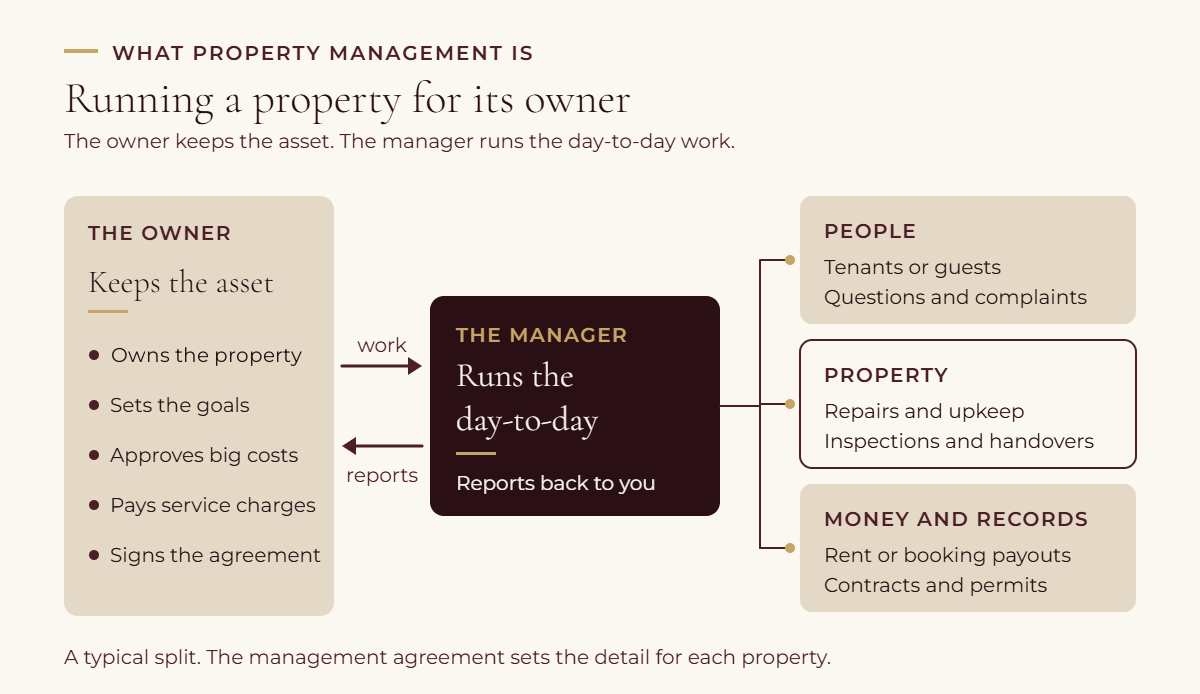
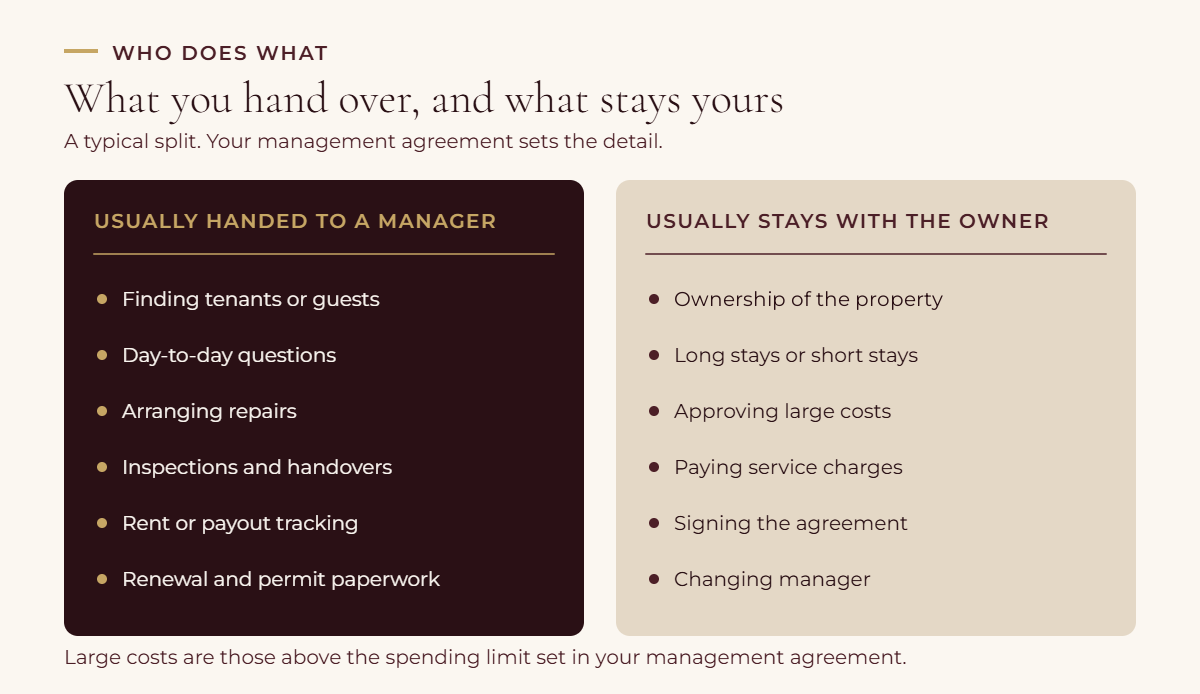
Property management is the day-to-day running of a property on its owner’s behalf: finding and looking after the people who live in or stay at it, keeping it maintained, collecting the income and handling the paperwork. The owner keeps the property and the big decisions, while the manager does the routine work and reports back.
In Dubai, what that work involves depends on how the property is used. A flat let to a tenant on a yearly contract, a holiday home let by the night and the shared parts of a tower each come under different rules: RERA, part of the Dubai Land Department, oversees tenancies and jointly owned buildings, and DTCM (now part of Dubai’s Department of Economy and Tourism) licenses holiday homes.
This guide explains what property management means, the main types in Dubai, what a property manager does, how it differs from facility and community management, and the rules that shape the job, as of 22 October 2026. For the service itself, see our page on holiday homes operation management for property owners.
Key Takeaways
- Property management is the day-to-day running of a property for its owner: people, upkeep, money and paperwork.
- Dubai has three main kinds for homes: long-term letting, holiday homes and the management of shared buildings, each with its own rules.
- Tenancies follow Law No. 26 of 2007 and are registered through Ejari; every holiday home needs its own DTCM permit.
- Facility and community management look after the building and its shared parts, funded by service charges, not your own unit.
- Managing other people’s property is a licensed activity, so check which licence covers the service you are buying.
What Property Management Means
A property manager acts in the owner’s place. Dubai’s tenancy law allows for this: in Law No. (26) of 2007, the word landlord includes an agent or legal representative of the landlord. In practice, the job falls into four areas:
- People: finding and checking tenants or guests, answering their questions and dealing with complaints.
- Property: arranging repairs, routine maintenance and inspections, and checking the condition at the start and end of each tenancy or stay.
- Money: collecting rent or tracking booking payouts, paying agreed bills and keeping the records.
- Paperwork: contracts, registrations, permits and renewals, plus regular statements for the owner.
What a particular manager does is set by the management agreement, not by a standard definition, so two companies can both offer property management and cover different work. The idea stays the same: the owner decides, and the manager runs the property within limits the owner sets.
Types of Property Management in Dubai
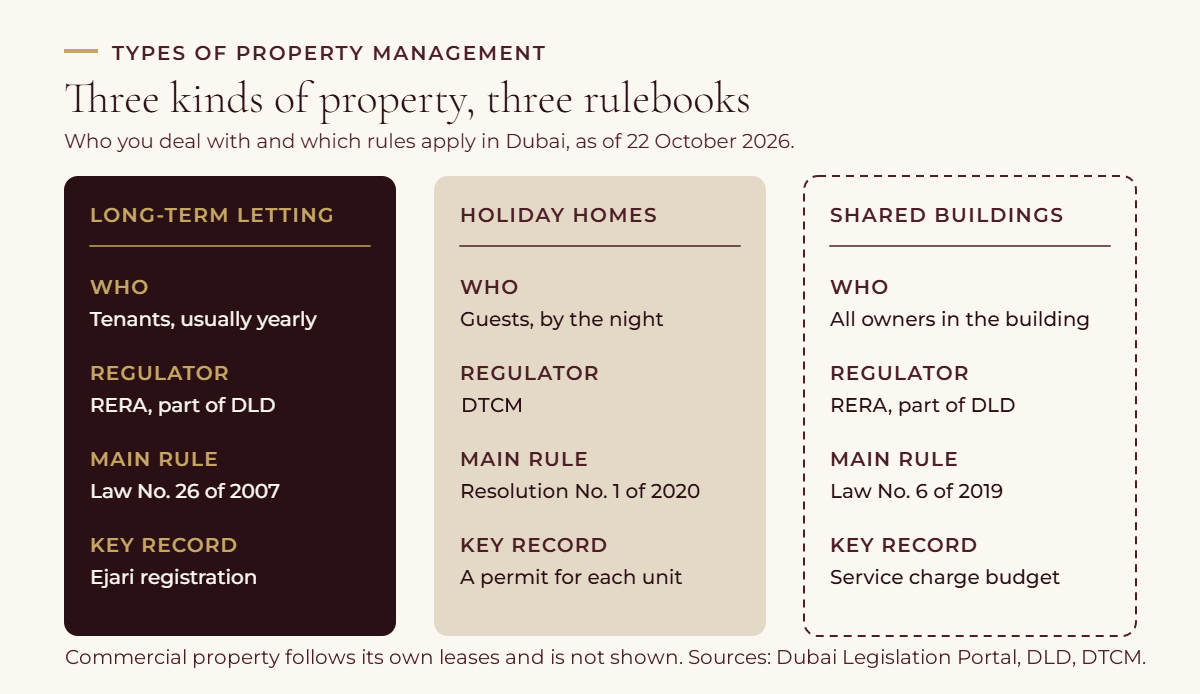
Most owners of homes in Dubai meet three kinds of property management, and each comes with a different set of rules.
Long-Term Residential Letting
The manager finds a tenant, agrees a contract, usually for a year, and looks after the tenancy until it ends or renews. Under Law No. 26 of 2007, lease contracts must be registered with RERA, which is done through the Ejari system, and the unified tenancy contract commits the landlord to registering it. Disputes go to the Rent Disputes Settlement Centre, which replaced the special tribunal named in that law in 2013.
Holiday Home Management
Here the property is let furnished, by the night, to visitors. Every unit must be registered and approved by DTCM before it is listed, the permit number must appear in every advert, and the other duties that come with the permit are set out in Administrative Resolution No. (1) of 2020. The work is daily rather than yearly: pricing, guest messages, check-ins, cleaning between stays and guest records. Our guide to what a holiday home management company does explains the two ways a unit can be registered. Requirements change, so check the current rules with DTCM before applying.
Owners Association and Community Management
In a building with many owners, someone has to run the lifts, pools, corridors and other shared parts. Law No. (6) of 2019 gives this job to a management entity, such as a management company recognised by RERA, and each owner pays a share of the annual service charges to it. This manages the building as a whole, not your unit.
Commercial Property Management
Offices, shops and warehouses are managed in a similar way, with longer leases, fit-out rules and business tenants. This guide focuses on homes, where most individual owners start.
What a Property Manager Does
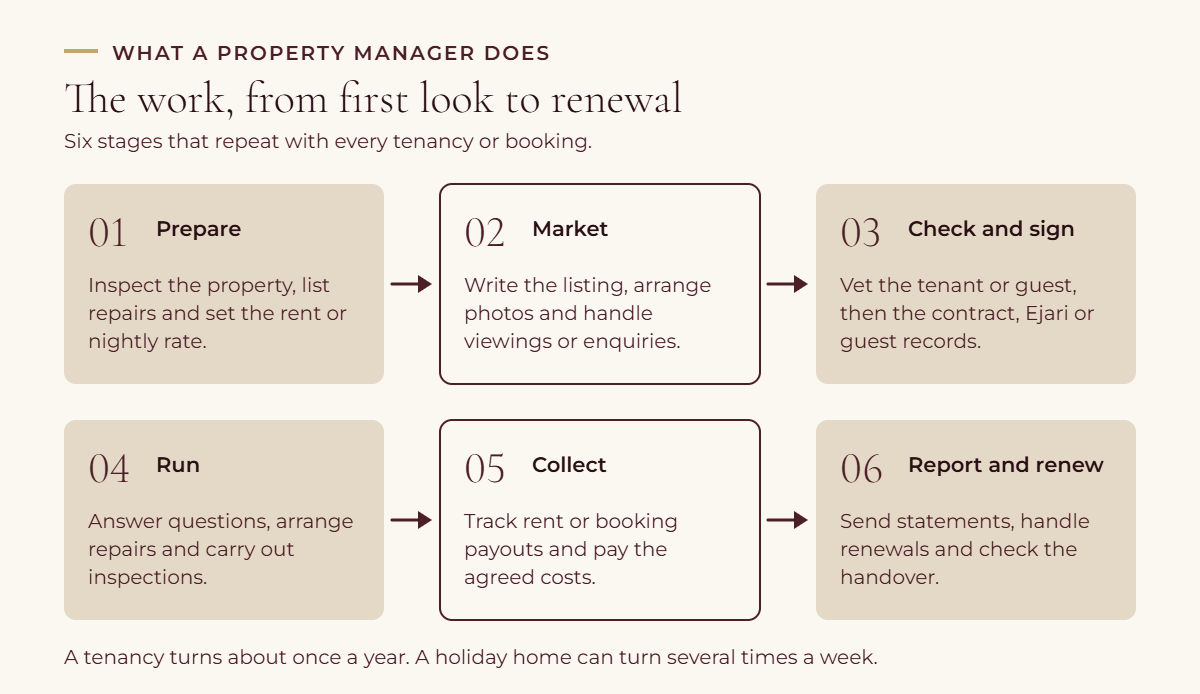
The work follows the life of a tenancy or a booking. A typical cycle runs through six stages:
- Prepare: inspect the property, list the repairs and set a rent or nightly rate.
- Market: write the listing, arrange photos and handle viewings or enquiries.
- Check and sign: vet the tenant or guest, then complete the contract, the Ejari registration or the guest records.
- Run: answer questions, arrange maintenance and repairs, and carry out inspections.
- Collect: track rent cheques or booking payouts, and pay the costs you have agreed.
- Report and renew: send statements, handle renewals and check the property at handover.
Long-term letting and holiday homes share these stages but move at a different pace. A tenancy cycle turns about once a year. A holiday home can turn several times a week, which is why it needs a team on call for check-ins, cleaning and guest messages. Our page on Airbnb management in Dubai shows what that daily work looks like for a short-term rental.
Property, Facility and Community Management Compared
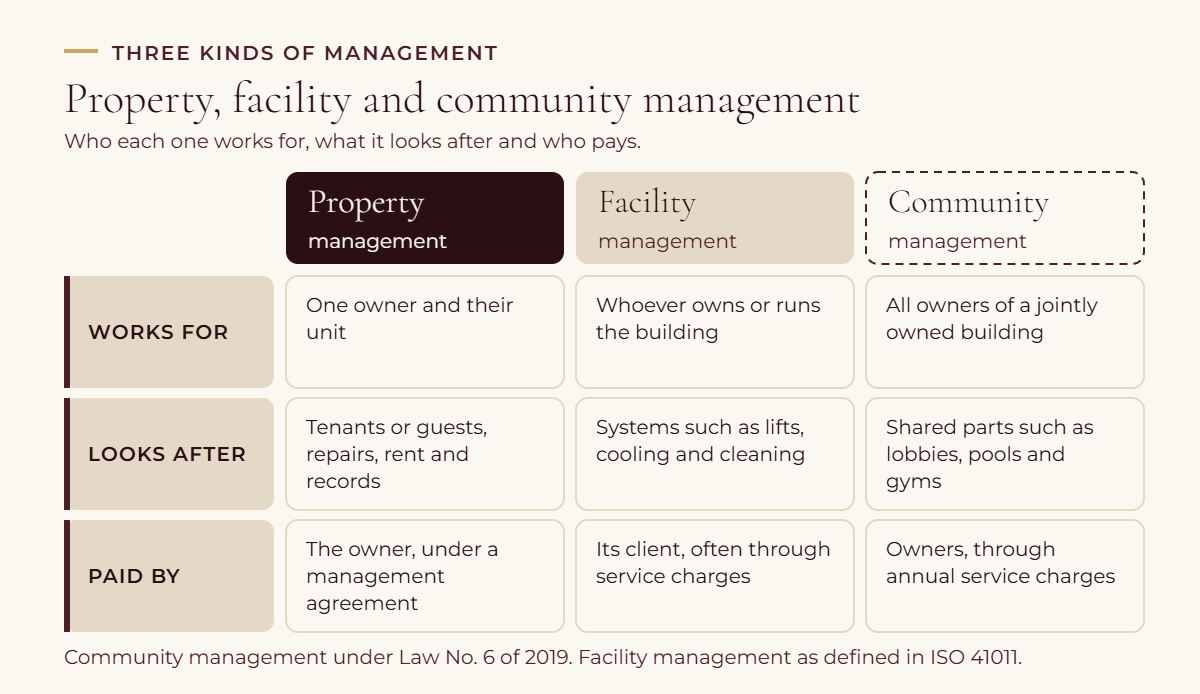
The three terms are often mixed up, and the difference matters when you need to know who to call and who to pay.
- Property management looks after your unit and the people in it, for you.
- Facility management looks after a building’s systems and services, such as lifts, cooling and cleaning. ISO’s facility management committee describes it as a function that brings together people, place and process in the built environment, to improve people’s quality of life and the productivity of the core business.
- Community management runs the shared parts of a jointly owned building for all its owners. Under Law No. 6 of 2019, once at least 10% of the units are registered, an Owners Committee appointed by RERA, of up to nine members in most building types, checks that the shared parts are managed, maintained and repaired.
A property manager often deals with the other two for you, for example booking the service lift for a move-in or reporting a cooling fault to the building. The service charges themselves stay with the owner: the Dubai Land Department confirms that owners must pay service and usage charges for jointly owned property unless a lease says otherwise.
The Rules That Shape the Job in Dubai
Much of a manager’s work is set by law. These are the rules owners meet most often, as of 22 October 2026.
Tenancies
Law No. 26 of 2007 sets the main duties. Unless the contract says otherwise, the landlord is responsible for maintenance during the tenancy (Article 16), and the tenant must look after the property as an ordinary person would look after their own (Article 19). A party that wants to change the terms at renewal, including the rent, must give notice at least 90 days before the contract ends, unless both sides agreed otherwise (Article 14).
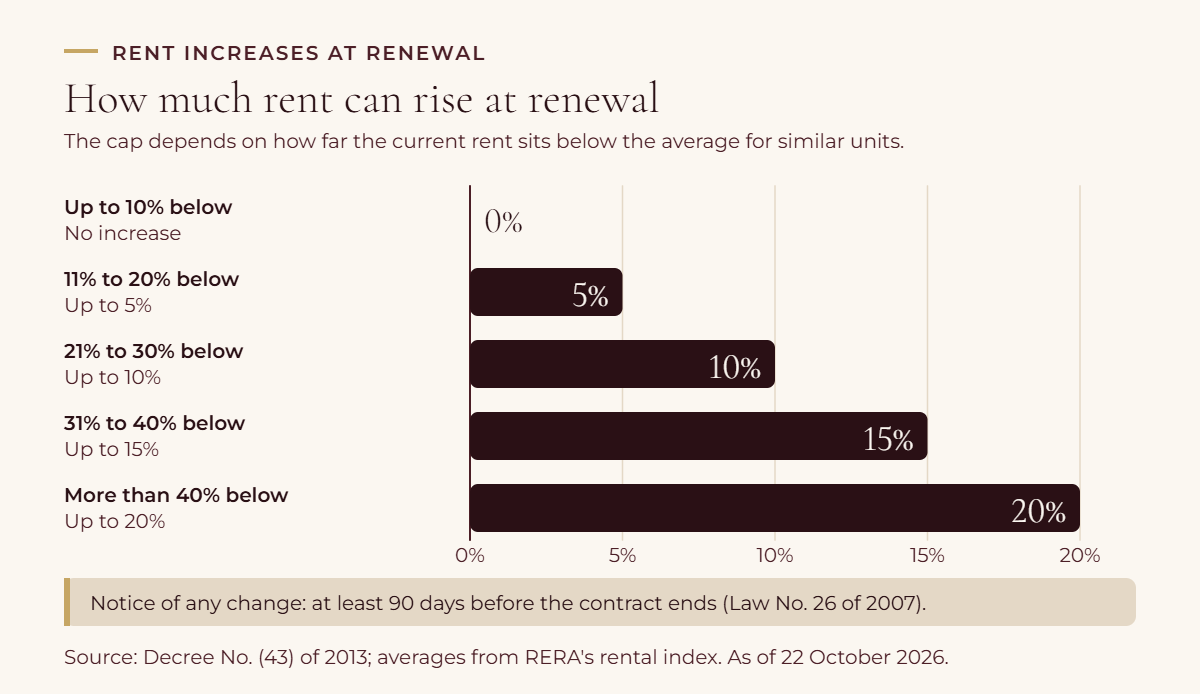
Rent increases at renewal are capped by Decree No. (43) of 2013. There is no increase if the current rent is up to 10% below the average for similar units, rising in steps to a maximum of 20% where it is more than 40% below. The average comes from RERA’s rental index, and the Dubai Land Department launched its Smart Rental Index on 2 January 2025, built on a building classification system.
Holiday Homes
Each permit covers one unit, is valid for one year and can be renewed. DTCM’s Holiday Homes System user guide explains that renewal opens only in the 30 days before expiry and that guest check-ins are recorded on a separate system, Holiday Homes 2.0. It also shows who can register a unit: the owner, for units they own, or a company with a valid licence. Our guide to what a management fee includes covers the government charges that come with a permit.
Who Can Manage Property for Others
Managing property is a licensed real estate activity. The Dubai Land Department’s list of real estate activities separates private property leasing and management, which is limited to property of the licence holder and second-degree relatives, from third-party property leasing and management, which requires a bank guarantee of AED 5 million. Supervising jointly owned property is another activity, and the licence and its staff must be registered with RERA. Ask any company which licence covers the work it is offering you.
Benefits of Property Management for Owners
The main benefit is time. A manager takes on the calls, the contractor visits and the paperwork, which matters most if you live abroad or own more than one unit. Other benefits follow from that:
- Compliance: registrations, permits and renewals are handled on time by people who do them every week.
- Upkeep: small faults are fixed before they grow, and inspections leave a record of the property’s condition.
- Quick answers: enquiries, viewings and guest messages get a reply without waiting for you.
- Records: one set of statements, invoices and contracts, which helps at tax time or when you sell.
There are trade-offs. You pay a fee and give up some day-to-day control, so the agreement should set what the manager can decide alone and what needs your approval. Our guide to how management fees are structured compares the main fee models, and our clauses to check in a management agreement cover approval limits and exit terms.
Which Kind of Management Do You Need?
Start with how you want to use the property, because the type of letting decides the type of management. A yearly tenancy suits owners who want a steady arrangement with little day-to-day work. A holiday home suits owners who are ready for more activity, a permit and a building that allows short stays. Either way, the building’s own management company runs the shared parts.
Signature Prospera, an owner-first holiday homes operation management company in Dubai, focuses on short-term rentals. The holiday home permit is issued in your name, rental income goes to your own bank account after every booking, and our single flat monthly fee is invoiced separately.
Quick Action Checklist
| Item | What to check | Why it matters |
|---|---|---|
| Type of letting | Long-term, holiday home or both | It decides the rules and the work |
| Building approval | Whether short stays are allowed | A developer NOC may be needed |
| Manager’s licence | Which activity the licence covers | Managing others’ property is licensed |
| Scope of service | What is included and what is extra | Scope differs between companies |
| Approval limit | Spending allowed without asking you | You keep control of large costs |
| Registration | Ejari or DTCM permit, and in whose name | It shows who holds the record |
| Reporting | How often statements arrive | You see every payment and cost |
| Service charges | Who pays them, and when | They stay with the owner |
| Renewal dates | Who tracks them and the notice | Tenancy changes need 90 days’ notice, unless agreed otherwise |
| Exit terms | Notice period and handover | You can change manager cleanly |
Start With the Type of Letting
Property management means the same thing everywhere, but in Dubai the type of letting decides the rules, the authority and the work. Decide how you want the property used, check that the building allows it, then compare managers on scope, licence and reporting rather than headline price.
If you’re weighing up short stays for an apartment or villa, book a free rental assessment and we’ll give you an honest view on whether they suit your property.
Frequently Asked Questions
What is property management in simple terms?
It is the day-to-day running of a property for its owner: finding and looking after tenants or guests, arranging maintenance and repairs, collecting the income and handling contracts, registrations and reports. The owner keeps the property and the big decisions.
What are the main types of property management in Dubai?
For homes, there are three: long-term residential letting, holiday home management, and owners association or community management. Commercial property management covers offices, shops and warehouses. Tenancies follow Law No. 26 of 2007, holiday homes need a DTCM permit and shared buildings follow Law No. 6 of 2019.
What does a property manager do day to day?
A property manager answers tenant or guest questions, arranges repairs and inspections, tracks rent or booking payouts, keeps contracts and registrations up to date, and sends the owner regular statements.
What are the benefits of property management?
It saves the owner time, keeps registrations and renewals on schedule, gets faults fixed promptly and leaves a clear record of income and costs. It suits owners who live abroad or own several units. The trade-offs are the fee and some loss of day-to-day control.
What is the difference between property management and facility management?
Property management looks after one owner’s unit and the people in it. Facility management looks after a building’s systems and services, such as lifts, cooling and cleaning, usually for the building as a whole.
Is property management the same as owners association management?
No. In a jointly owned building, a management company runs the shared parts for all owners, funded by service charges. A property manager works for you and looks after your own unit.
Do property management companies in Dubai need a licence?
Yes. Managing property for others is a licensed real estate activity on the Dubai Land Department’s list, and a company that registers holiday homes with DTCM needs a valid licence. Ask which licence covers the service you are buying.
Who is responsible for maintenance in a rented property in Dubai?
Under Law No. 26 of 2007, the landlord is responsible for maintenance during the tenancy unless the contract says otherwise, and the tenant must look after the property with ordinary care. A property manager arranges the work for the landlord.
Who pays service charges when a property is managed?
The owner, unless a lease says otherwise. Service charges for jointly owned buildings are paid to the building’s management entity, and a property manager may pay them for you and show them on your statement.
How much can rent go up at renewal in Dubai?
Increases follow Decree No. 43 of 2013 and RERA’s rental index: no increase if the rent is up to 10% below the average for similar units, rising to a maximum of 20% if it is more than 40% below. Notice of any change is due at least 90 days before the contract ends, unless both sides agreed otherwise.
This article is general information, not legal or financial advice.
Sources
- Dubai Legislation Portal, Law No. (26) of 2007 Regulating the Relationship between Landlords and Tenants in the Emirate of Dubai, accessed 22 October 2026
- Dubai Legislation Portal, Decree No. (26) of 2013 Concerning the Rent Disputes Settlement Centre in the Emirate of Dubai, accessed 22 October 2026
- Dubai Land Department, Ejari unified tenancy contract, accessed 22 October 2026
- Dubai Legislation Portal, Decree No. (43) of 2013 Determining Rent Increase for Real Property in the Emirate of Dubai, accessed 22 October 2026
- Dubai Land Department, Smart Rental Index announcement, 2 January 2025
- Dubai Legislation Portal, Law No. (6) of 2019 Concerning Ownership of Jointly Owned Real Property in the Emirate of Dubai, accessed 22 October 2026
- Dubai Land Department, Real estate property owner is obliged to pay service and usage charges for jointly owned property, 6 January 2020
- Dubai Land Department, Real estate activity license, accessed 22 October 2026
- International Organization for Standardization, ISO/TC 267 Facility management, accessed 22 October 2026
- Dubai Department of Economy and Tourism, Hospitality services and permits, accessed 22 October 2026
- Dubai Legislation Portal, Administrative Resolution No. (1) of 2020 Issuing the Implementing Bylaw of Decree No. (41) of 2013, issued 7 January 2020
- Dubai Department of Economy and Tourism, Holiday Homes System User Guide, accessed 22 October 2026