

One holiday home is a project. Several are a business. Investors who own more than one Dubai unit face the same rules for each, but the work, the reporting and the choice of manager change with scale.
This guide covers what changes, as of November 2026. It makes no promises about returns: what each unit earns depends on the unit, its building and the time of year.
Key Takeaways
- Every unit needs its own DET/DTCM permit, renewed each year.
- On the homeowner route, an owner can register up to eight units they own.
- Track each unit separately: occupancy, nightly rate, costs and net income.
- Standardise setup, supplies and house rules across units to save time.
- Choose a manager whose reports show every unit and every cost.
The Rules Apply Unit by Unit
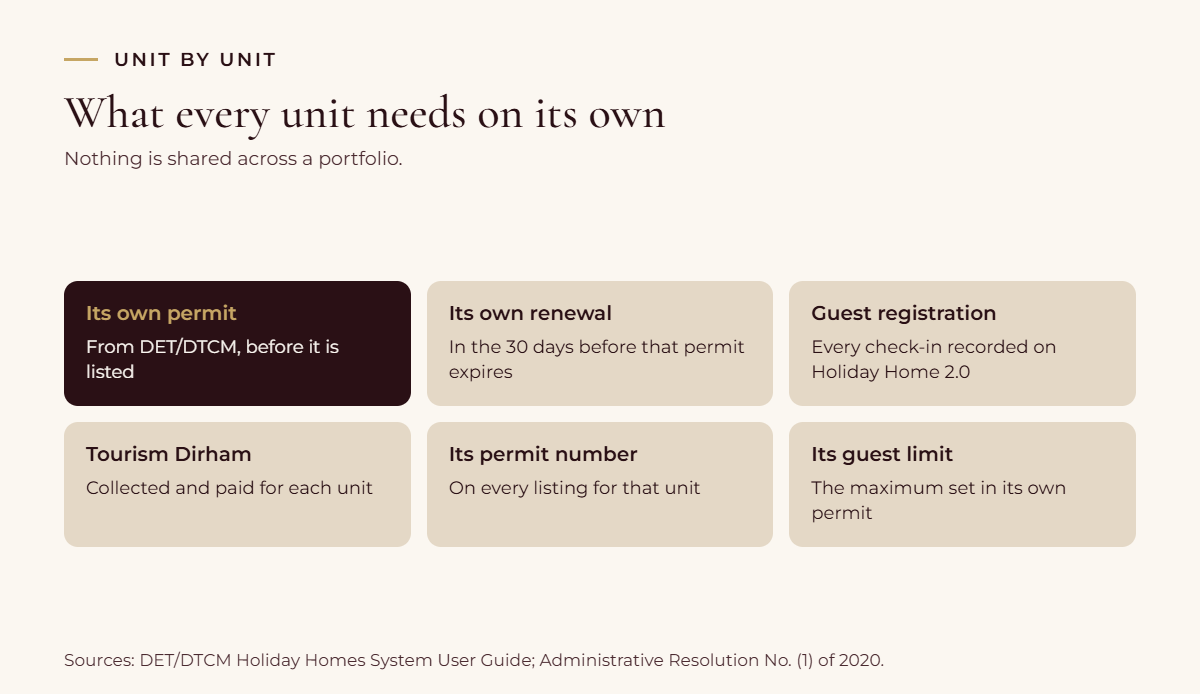
Nothing in Dubai’s holiday home rules is shared across a portfolio. Each unit needs its own permit, its own renewal in the 30 days before expiry, its own guest records, its own Tourism Dirham entries and its own guest limit set by its permit. Each listing shows that unit’s permit number.
As of November 2026, homeowners can register up to eight units they own on the homeowner route. A licensed operator can also register units under its own licence, in which case the operator carries the licensee duties and each permit ends with your agreement. Our guide to Airbnb co-hosting in Dubai explains how each route works with a manager.
Track Every Unit on Its Own
Portfolio totals hide problems: one weak unit can sit behind two strong ones for months. Track each unit separately.
| Measure | Why it matters for each unit |
|---|---|
| Occupancy | Shows which units are under-booked |
| Average nightly rate | Shows whether a unit is priced too low or too high for its building |
| Income per available night | Puts rate and occupancy into one comparable figure |
| Costs per stay | Cleaning, supplies and commission differ by size and platform mix |
| Net income | What each unit leaves after all its costs |
| Reviews | Repeated comments point to fixes in a specific unit |
Our guide to Airbnb revenue management in Dubai explains how these numbers work together.
Standardise Where You Can
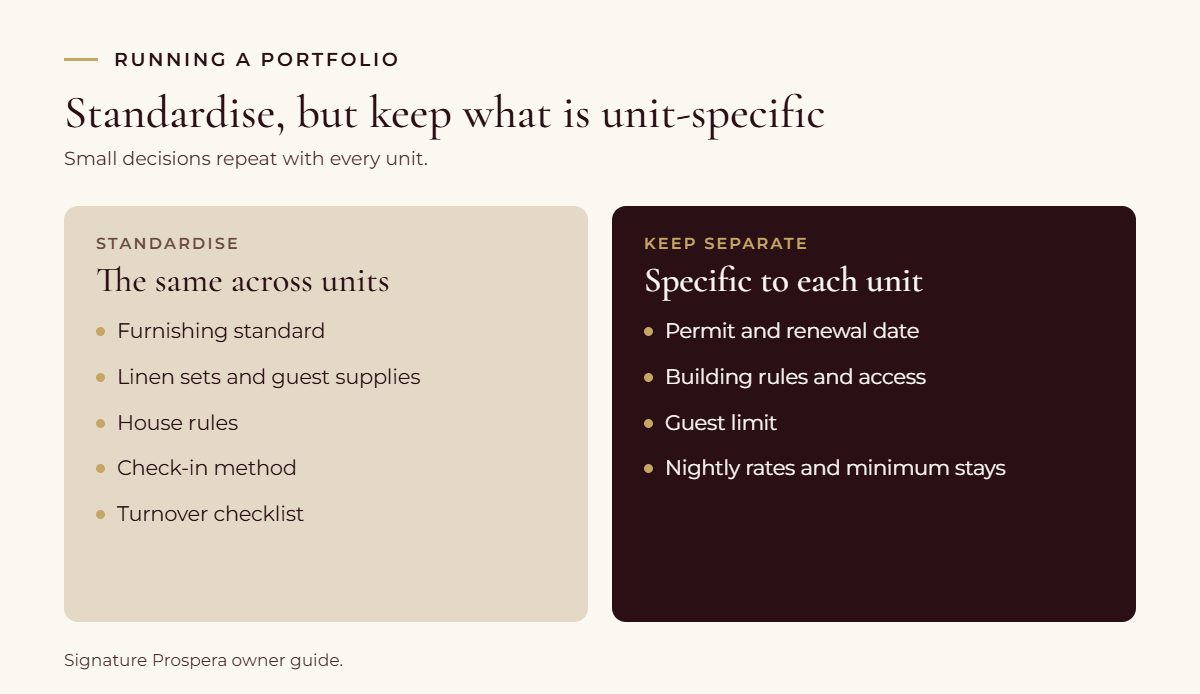
With several units, small decisions repeat. Use the same furnishing standard, linen sets, guest supplies, house rules and check-in method across units where the buildings allow it. Spare linen and supplies can then move between units, and every cleaner works to the same checklist. Keep the unit-specific details separate: each permit, renewal date, guest limit, building rules and price.
Units in One Building, or Across the City
Several units in one building share access arrangements, building rules and a cleaning route, which makes operations simpler. They also compete for the same guests on the same dates, so pricing needs care. Units in different areas spread that risk but take more travel and coordination.
What to Ask a Manager When You Own Several Units
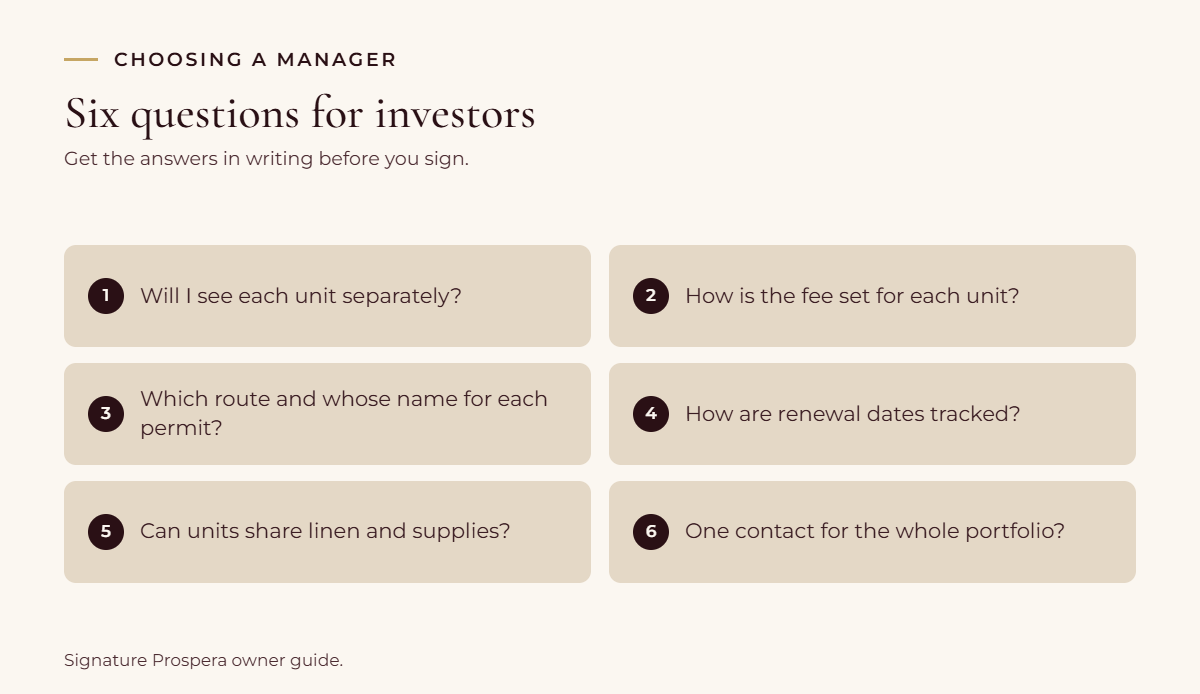
- Will I see each unit separately in the dashboard and the statements?
- How is the fee set for each unit?
- Which registration route will you use for each unit, and whose name will each permit be in?
- How are permit renewal dates tracked across units?
- Can units share linen and supplies, and how is that charged?
- Will I have one point of contact for the whole portfolio?
How Signature Prospera Works With Investors
We manage anything from a single unit to a whole building, to each owner’s requirements. Each unit is set up, listed and priced on its own, with its permit in your name, and one team runs the guests, cleaning, maintenance and paperwork across all of them. You pay one flat monthly fee based on each property type, with no revenue share, and see every booking and cost in your owner dashboard, with a revenue update every 15 days and a Statement of Accounts by the 5th of each month.
If you live outside the UAE, our guide to managing a Dubai Airbnb from abroad covers the extra checks. Read what Airbnb management covers, see our Airbnb management in Dubai service, or book a free rental assessment for your units.
More Airbnb Management Guides
- What Is Airbnb Management? A Guide for Dubai Owners
- Airbnb Guest Management in Dubai, From Enquiry to Checkout
- Airbnb Listing Management: Keeping a Dubai Listing Booked
- Airbnb Revenue Management in Dubai: Rates, Stays, Seasons
- Airbnb Co-Hosting in Dubai: How Host Management Works
- Managing a Dubai Airbnb From Abroad: What Owners Need
- Airbnb Villa Management in Dubai: What Changes for a Villa
- Airbnb Check-In in Dubai: Keys, Access Cards, Smart Locks
- Airbnb Management Software: Tools Behind a Dubai Listing
Frequently Asked Questions
How many holiday homes can I register in Dubai as an owner?
As of November 2026, homeowners can register up to eight units they own on DET/DTCM’s homeowner route. A licensed operator can also register units under its own licence.
Does each Airbnb unit in Dubai need its own permit?
Yes. Each unit needs its own DET/DTCM permit, renewed each year in the 30 days before it expires, with its own guest records and Tourism Dirham entries.
Can one company manage all my units?
Yes. Ask how the fee is set for each unit, which registration route it will use and whether you will see every unit separately in the reports.
How should I compare the performance of several units?
Track each unit on its own: occupancy, average nightly rate, income per available night, costs per stay, net income and reviews. Portfolio totals can hide a weak unit.
Is it better to own several units in one building?
It has trade-offs. One building simplifies access, rules and cleaning routes, but the units compete for the same guests on the same dates. Units in different areas spread that risk.
Can a manager promise returns across my portfolio?
No manager can promise a figure. Signature Prospera gives a low, an expected and a high case in writing for each unit, based on booked rates for similar units.
Sources
- Dubai Department of Economy and Tourism, Holiday Homes System User Guide, accessed November 2026
- Dubai Department of Economy and Tourism, Renew a Holiday Homes permit, accessed November 2026
- Dubai Legislation Portal, Administrative Resolution No. (1) of 2020 Issuing the Implementing Bylaw of Decree No. (41) of 2013, accessed November 2026
- Dubai Legislation Portal, Executive Council Resolution No. (2) of 2014 Approving the Tourism Dirham Fee, accessed November 2026
About the Author
Madhuri Chari is the Founder and CEO of Signature Prospera, which provides holiday homes operations management in Dubai and Sharjah. She built the company around an owner-first approach, drawing on years of work in brand strategy, client relations and operational leadership. Connect with her on LinkedIn.
This article is general information, not legal or financial advice.