

Flat fee property management in Dubai is simple to describe: you pay the same amount every month, whatever your holiday home earns. The harder question is whether it costs you more or less than a revenue share. The answer depends on your revenue, and a few lines of arithmetic will tell you.
This guide compares the two models with worked examples for a quiet month, an average month, a busy month and a full year. The numbers are illustrations to show the method. They are not market averages and they are not a quote.
Key Takeaways
- A revenue share charges a percentage of booking revenue, so the fee moves with your income.
- A flat fee stays the same each month, so it costs relatively more in quiet months and less in busy ones.
- Every comparison has a break-even point: the revenue at which both models cost the same.
- Above the break-even, a flat fee leaves you with more; below it, a revenue share does.
- Compare what each fee covers, because extras can matter as much as the headline rate.
How each model works
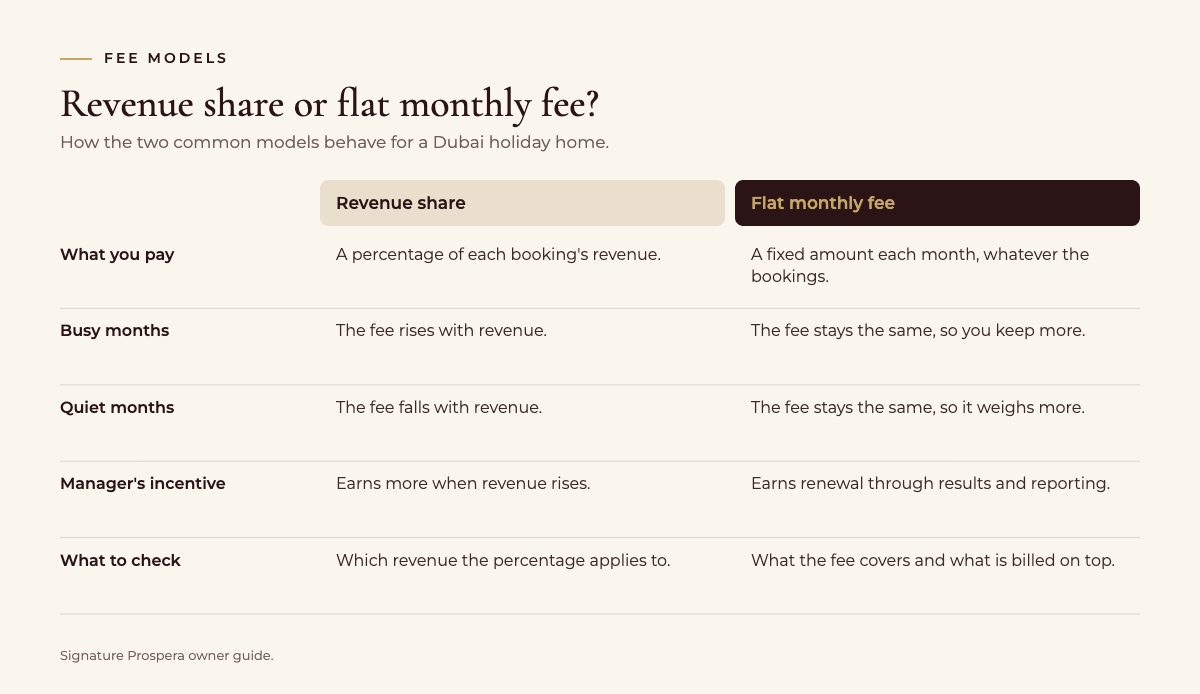
With a revenue share, the manager takes an agreed percentage of the revenue from each booking. The fee rises in December and falls in August. With a flat fee, you agree a fixed monthly amount, often set by property type, and it stays the same through the year.
Both models can be fair. What matters is that you compare them on the same basis and on a realistic year of bookings, not on your busiest month.
The break-even point
The quickest way to compare is to find the monthly revenue at which both fees are equal. Divide the flat fee by the percentage.
For example, a flat fee of AED 2,000 and a revenue share of 20% break even at AED 10,000 of monthly revenue, because 20% of AED 10,000 is AED 2,000. If your home earns more than AED 10,000 in a month, the flat fee costs less. If it earns less, the revenue share costs less.
Over a year, the same logic applies to annual figures. A flat fee of AED 24,000 a year breaks even with a 20% share at AED 120,000 of annual revenue.
Worked examples
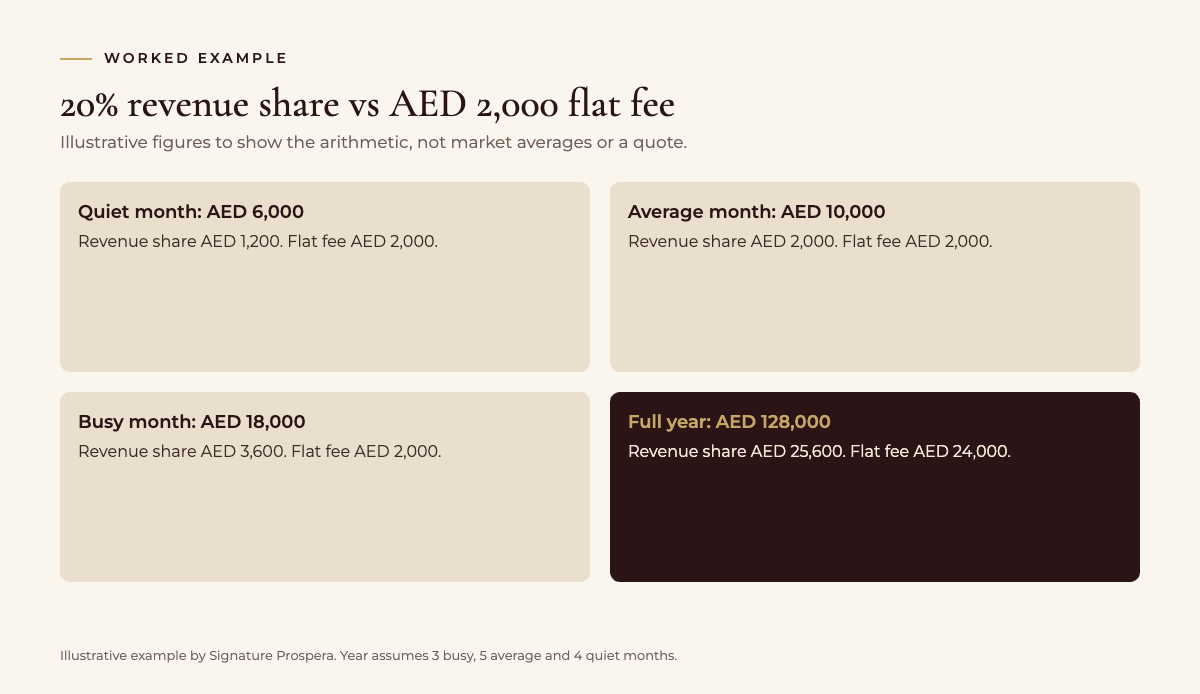
Take an illustrative one-bedroom holiday home and compare a 20% revenue share with an illustrative flat fee of AED 2,000 a month.
| Month type | Revenue | 20% revenue share | Flat fee |
|---|---|---|---|
| Quiet | AED 6,000 | AED 1,200 | AED 2,000 |
| Average | AED 10,000 | AED 2,000 | AED 2,000 |
| Busy | AED 18,000 | AED 3,600 | AED 2,000 |
Now build a full year from three busy months, five average months and four quiet months. Total revenue is AED 128,000. The revenue share costs AED 25,600, and the flat fee costs AED 24,000, so the flat fee leaves the owner AED 1,600 better off. In a stronger year, the gap widens. In a weaker year, it narrows or reverses.
What the examples leave out
Headline fees are only part of the cost. Before you compare, check these points for each quote.
- The revenue base. A percentage of gross revenue costs more than the same percentage of revenue after platform fees.
- Cleaning and linen. Some managers include coordination; others add a margin to each clean.
- Repairs. Ask whether maintenance is billed at cost with receipts or with a markup.
- Setup and photography. Check for one-off charges before the first booking.
- Payout flow. Ask whether platforms pay you directly or the manager collects first.
Our guide to holiday home management fees and what they include covers each line in more detail, and our overview of short-term rental management fees in Dubai explains the common structures.

When a flat fee suits you
- Your home earns strong revenue across most of the year.
- You want a predictable monthly cost for budgeting.
- You prefer that the manager’s pay does not rise when your rates do.
When a revenue share may suit you
- Your home is new and its revenue is uncertain.
- Your income is highly seasonal, with long quiet periods.
- You want the fee to fall automatically in a weak month.
How Signature Prospera charges
Signature Prospera charges one fixed fee, set by your property type. There is no revenue share and no hidden percentage. Rental income from the booking platforms goes to your bank account, and our fee is invoiced separately. The fee covers listings, guest management, compliance support, and housekeeping and maintenance coordination. There are no subscription plans, and we confirm the fee for your property when you contact us.
See our fixed fee page for details, or book a free rental assessment to see the numbers for your own home.
More Airbnb Management Guides
Frequently Asked Questions
What is flat fee property management?
It is a management model where you pay a fixed amount each month, whatever your holiday home earns. The fee does not rise in busy months or fall in quiet ones.
How do I compare a flat fee with a percentage?
Divide the flat fee by the percentage to find the break-even revenue. Above that revenue the flat fee costs less, and below it the percentage costs less.
Is a flat fee cheaper than a revenue share in Dubai?
It depends on your revenue across the whole year. Homes with strong, steady bookings usually pay less under a flat fee.
What should a flat management fee include?
It should cover listings, pricing, guest communication, compliance support and coordination of cleaning and maintenance. Ask for the full list in writing, along with any charges billed on top.
Does Signature Prospera take a share of rental income?
No, Signature Prospera charges one fixed fee based on property type, with no revenue share. Rental income goes to your bank account and the fee is invoiced separately.
Sources
- Signature Prospera: How our fixed fee works
- Signature Prospera: Owner FAQ
- Signature Prospera: Holiday home management fees in Dubai, what’s included
About the Author
Madhuri Chari is the Founder and CEO of Signature Prospera, which provides holiday homes operations management in Dubai and across the UAE. She built the company around an owner-first approach, drawing on years of work in brand strategy, client relations and operational leadership. Connect with her on LinkedIn.
This article is general information, not legal or financial advice.