

Airbnb pricing in Dubai follows the weather, the event calendar and the flight schedule more than any fixed rule. A rate that works in July leaves money on the table in December, and a December rate empties the calendar in August. Owners who price month by month, and then date by date, earn more from the same home.
This guide sets out how demand moves through the Dubai year, which dates deserve special attention and how to set rates for each season. It draws on public tourism data and on how we price the homes we manage.
Key Takeaways
- Dubai’s peak runs from November to March, and December 2025 was the busiest month on record with 2.04 million visitors.
- Events such as National Day, the Dubai Shopping Festival and New Year’s Eve move rates more than the month itself.
- Summer demand is lower, so weekly and monthly rates often earn more than cutting the nightly price.
- 2026 showed how fast demand can change, so review rates weekly, not once a season.
- Price against similar homes in your own building and area, not the city average.
The Dubai demand curve
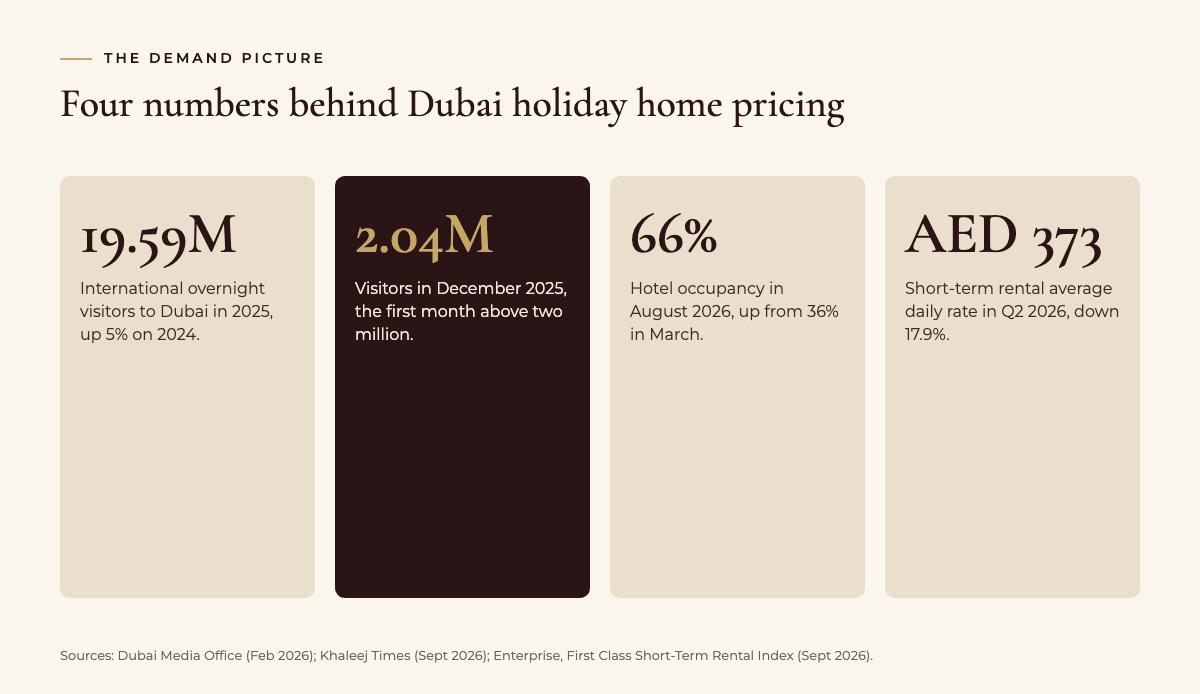
Dubai welcomed 19.59 million international overnight visitors in 2025, up 5% on 2024, and hotels averaged more than 80% occupancy. The year ended with 2.04 million visitors in December alone, beating the previous monthly record of 1.94 million set in January 2025.
2026 has looked very different. The regional conflict from late February cut leisure travel, and hotel occupancy fell to 36% in March before recovering to 66% in August. For short-term rentals, the First Class index reported second-quarter occupancy of 47.7% and an average daily rate of AED 373, down 17.9% on a year earlier. The lesson for pricing is simple: the calendar gives you a starting point, and live booking data tells you where to go from there.
Month by month
| Months | What drives demand | Pricing approach |
|---|---|---|
| November | Cooler weather, events and the start of the winter season | Lift rates from mid-month and set minimum stays on event dates |
| December | National Day, Dubai Shopping Festival, Christmas and New Year | Highest rates of the year, longer minimum stays over New Year |
| January to February | Winter sun from Europe, the second half of the Shopping Festival | Strong rates, with weekly offers for long winter stays |
| Ramadan (expected from around 8 February 2027) | Quieter leisure demand during the month, busier around Eid | Soften midweek rates, lift the Eid dates |
| March to April | Late winter and spring holidays | Firm rates early, easing as temperatures rise |
| May to June | Shoulder season, Eid Al Adha and GCC travel | Event-led pricing around the holidays, weekly rates elsewhere |
| July to August | Summer heat, fewer leisure visitors | Weekly and monthly rates, corporate and relocation stays |
| September to October | Return of business travel and trade events | Rebuild rates from late September, lift trade-show dates |
Religious holiday dates depend on the moon sighting, so confirm them as each one approaches.
The dates that matter most
Some dates outsell their month. UAE National Day falls on 2 and 3 December 2026, and public sector workers have a holiday from 2 to 4 December, which creates a long weekend for residents and GCC visitors. The Dubai Shopping Festival runs from 4 December 2026 to 17 January 2027, with nightly light shows from 5 December. New Year’s Eve is the single strongest night of the year for most Dubai homes. Set these dates early, with minimum stays, before the calendar fills at standard rates.

How to set the nightly rate
Start from your comparables
Look at similar homes in your building or the next street: same size, same view, same standard. A sea-view one-bedroom in Dubai Marina competes with other sea-view one-bedrooms, not with the city average.
Adjust for the inputs
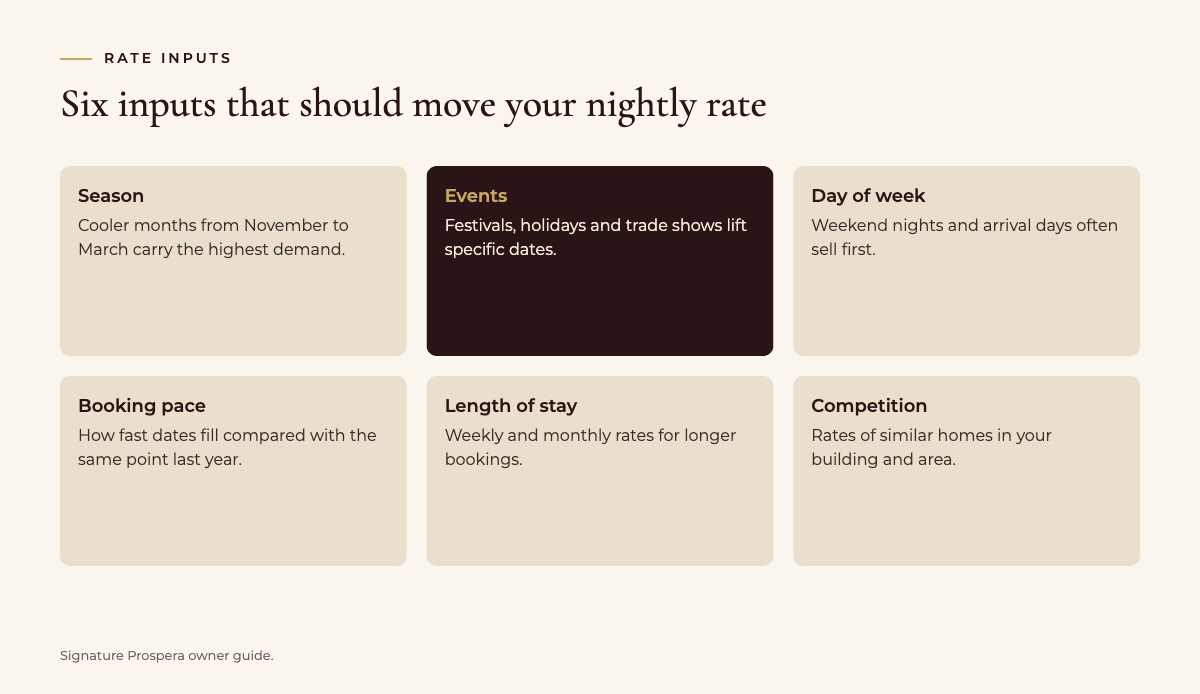
Raise or lower the base for season, events, day of the week and how fast your dates are filling. If your December dates fill much faster than last year, your rates are probably too low.
Use stay length as a lever
In quieter months, a weekly or monthly rate can earn more than a cheap nightly price, with fewer turnovers and lower cleaning costs. Our FAQ explains how we use weekly, monthly, corporate and relocation stays to keep occupancy up without cutting prices when there is no need.
Common pricing mistakes
- Setting one rate for the season and leaving it.
- Opening New Year’s Eve at a normal rate months in advance.
- Dropping prices in summer when a monthly rate would earn more.
- Copying the most expensive listing in the area without the same view or finish.
- Ignoring how fast your own calendar is filling.
For a deeper look at the methods behind this, read our guide to Airbnb revenue management in Dubai.
How Signature Prospera prices homes
We manage for total revenue across the year, and occupancy is one part of that. In practice, that means pricing by season and event, using weekly and monthly rates, and adjusting the mix of booking channels as demand changes. Owners get a pricing report based on data before we start, a revenue update every 15 days and a full statement of accounts by the 5th of each month.
Learn more about our vacation rental management in Dubai or book a free rental assessment for your home.
More Airbnb Management Guides
Frequently Asked Questions
Which month earns the most for a holiday home in Dubai?
December is usually the strongest month, and it set a record in 2025 with 2.04 million international visitors. January to March also carry high demand from winter-sun travellers.
How often should I change my Airbnb prices in Dubai?
Review rates at least weekly, and more often around events and holidays. 2026 showed that demand can shift within weeks.
Should I lower my price in summer?
Not always, because weekly and monthly rates often earn more than a low nightly price. Corporate and relocation stays also help fill the summer months.
How do events affect Dubai holiday home pricing?
Events such as National Day, the Dubai Shopping Festival and New Year’s Eve push demand above the normal level for their month. Set those dates early and use minimum stays.
What did 2026 do to Dubai short-term rental rates?
The First Class index reported a second-quarter average daily rate of AED 373, down 17.9% on a year earlier. Hotel occupancy has since recovered from 36% in March to 66% in August.
Sources
- Dubai Media Office: Dubai’s tourism industry achieves third successive record-breaking year (9 February 2026)
- Khaleej Times: Dubai hotels record 66% occupancy in August, highest in 6 months (13 September 2026)
- Enterprise: Scale and flexibility got Dubai’s holiday home operators through the war (8 September 2026)
- WAM: Dubai Shopping Festival to launch 32nd edition on 4th December (10 November 2026)
- The National: UAE confirms National Day holidays for private sector employees (13 November 2026)
- Signature Prospera: Owner FAQ
About the Author
Madhuri Chari is the Founder and CEO of Signature Prospera, which provides holiday homes operations management in Dubai and across the UAE. She built the company around an owner-first approach, drawing on years of work in brand strategy, client relations and operational leadership. Connect with her on LinkedIn.
This article is general information, not legal or financial advice.