
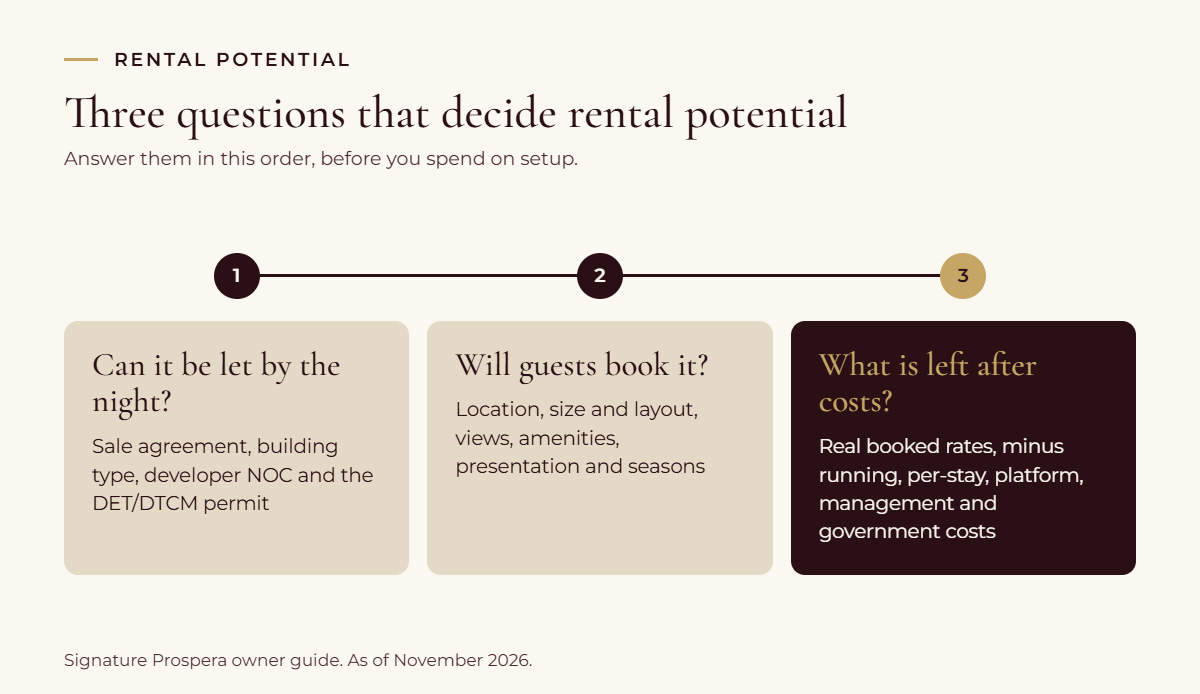
If you own an apartment or villa in Dubai, you may wonder whether it would work as a holiday home. To evaluate property value in that sense, ask three questions: can the unit be let legally by the night, will guests book it, and what is left after costs?
This guide shows how to evaluate a property for short stays, from the building rules and the permit from DET/DTCM (Dubai’s Department of Economy and Tourism) to demand, booked rates and costs. It does not estimate income, because that depends on your unit. Rules are stated as of November 2026.
Key Takeaways
- Check the rules first: your sale and purchase agreement and your building must allow holiday home use.
- Every unit needs its own DET/DTCM holiday home permit before it is listed, valid for one year.
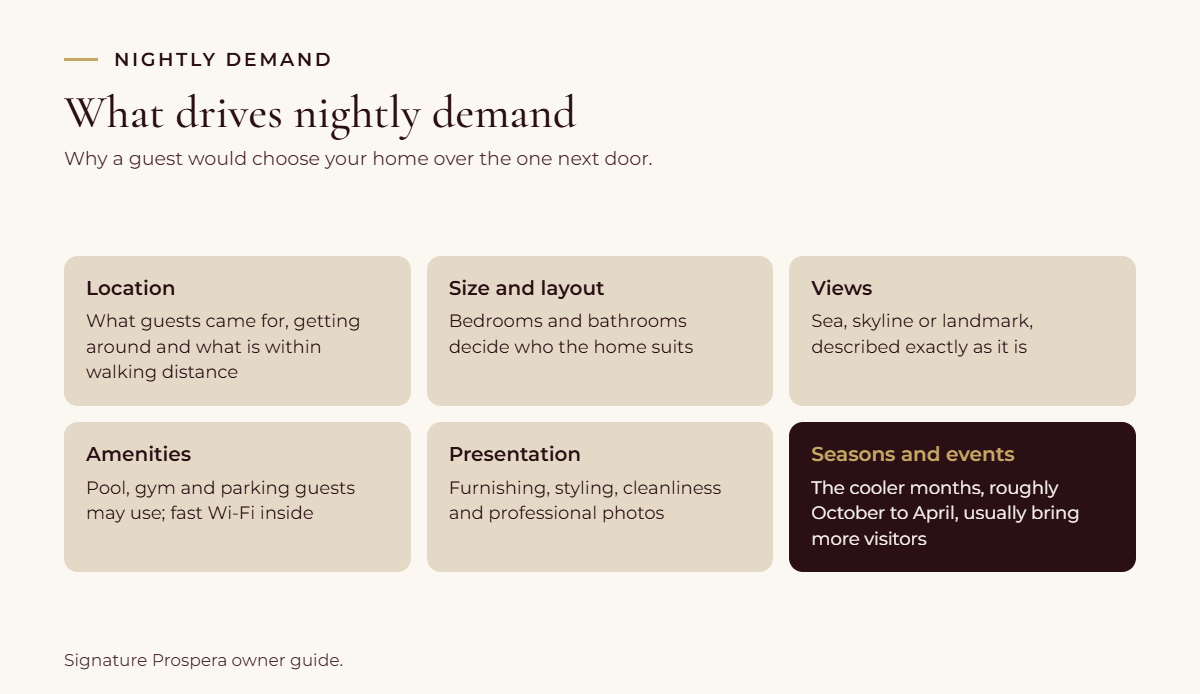
- Demand depends on location, size and layout, views, amenities, presentation, and seasons and events.
- Base your view on real booked rates for similar units in your building, with a low, expected and high case in writing.
- Subtract running costs, platform commissions, the management fee and government charges.
Check That Your Building Allows Short Stays
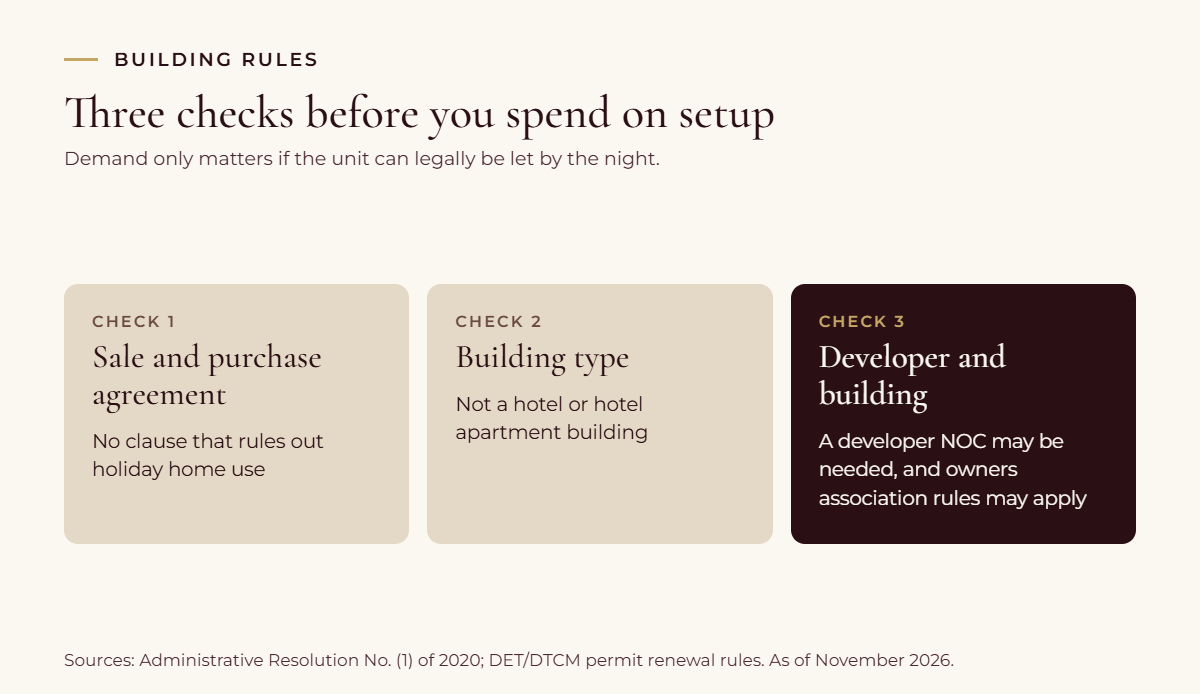
Demand only matters if the unit can legally be let as a holiday home. As of November 2026, run these three checks before you spend on furniture or photos.
- Your sale and purchase agreement. Under Administrative Resolution No. (1) of 2020, it must not contain a clause that rules out holiday home use.
- The building type. DET/DTCM’s permit renewal rules state that holiday homes are not permitted in hotel or hotel apartment buildings.
- The developer and the building. The same rules say a no objection certificate (NOC) from the developer may be needed. Your owners association may have its own rules too, so ask how guest access and parking work.
If the building rules out short stays, a yearly tenancy may suit that unit better. Our guide to what property management is explains how long-term letting works in Dubai.
Check Permit Eligibility With DET/DTCM
As of November 2026, DET/DTCM requires every holiday home to be registered and approved before it is listed, and each unit needs its own permit.
Who Can Hold the Permit
DET/DTCM’s Holiday Homes System user guide describes two account types: a Home Owner, for a property you own, and an Operator, a company with a valid licence. Under DET/DTCM’s registration requirements, homeowners can register up to eight holiday home units, and the DET/DTCM account and the permit are in the owner’s name. Our guide to what a holiday home management company does explains both routes.
What the Permit Commits You To
Under Administrative Resolution No. (1) of 2020, a permit is valid for one year, and the user guide explains that renewal opens only in the 30 days before expiry. Licensees must also hold comprehensive insurance that covers damage guests may suffer and stay within the maximum occupancy set in the permit, which caps how many guests your home can take. If you plan to run the home yourself, our guide to managing your Airbnb property yourself or with a manager sets out the other licensee duties.
What Drives Nightly Demand
Once the rules allow short stays, ask why a guest would choose your home.
Location
Guests choose first by where a home is: what they came to Dubai for, how easy it is to get around and what is within walking distance.
Size and Layout
Bedrooms and bathrooms decide who the home suits: a couple, a family or a group. A proper bed for everyone it sleeps makes the home easier to describe and to price.
Views
A sea, skyline or landmark view shows in the photos and helps guests choose. Describe it exactly as it is.
Amenities
Guests look at building facilities such as a pool, gym and parking, so check which ones short-stay guests may use. Inside, they expect fast Wi-Fi, a working kitchen, fresh linen and towels.
Presentation
Furnishing, styling, cleanliness and professional photos shape the first impression, and an accurate description sets the right expectations. Our guide to where to list your Dubai holiday home covers what makes a good listing.
Seasons and Events
The cooler months, roughly October to April, usually bring more visitors to Dubai, and Department of Economy and Tourism data published by the Dubai Media Office shows that 2025 was the city’s third record-breaking tourism year in a row. Major events, exhibitions and public holidays can push demand up for a few days, and summer is often quieter, so judge potential across the whole year.
Compare Real Booked Rates for Similar Units
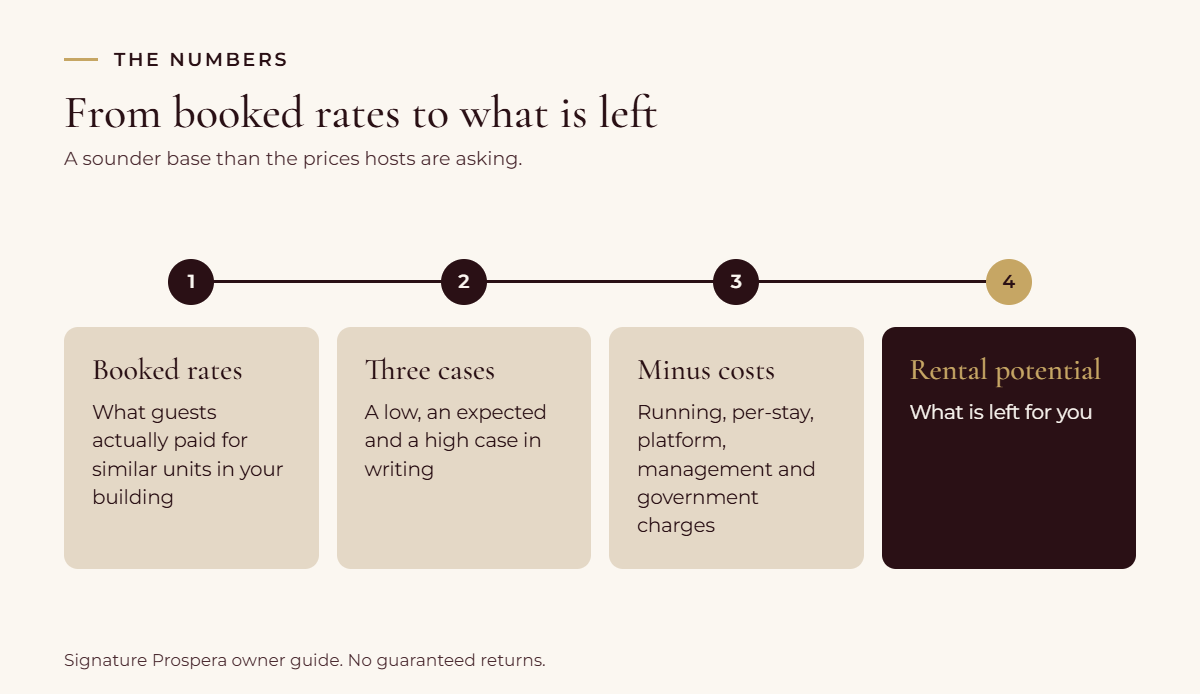
Prices shown on booking platforms tell you what hosts are asking, not what guests paid. A sounder base is the rates actually booked for similar units in the same building: the same number of bedrooms, a similar view and a similar standard.
Then ask for a low, an expected and a high case in writing, each with its assumptions: nightly rates in busy and quiet months, and the mix of nightly, weekly, monthly and corporate stays. No one can guarantee returns, so be wary of a projection built only on the busiest weeks.
Subtract the Costs
Rental potential is what is left after costs. Our guide to what holiday home management fees in Dubai include covers each line. The main groups are:
- Running costs: building service charges, DEWA, district cooling, gas, internet and insurance.
- Per-stay and upkeep costs: cleaning, laundry, guest supplies and repairs.
- Platform commissions: each booking platform’s own charge, which sits outside any management fee.
- The management fee: Signature Prospera charges one flat monthly fee by property type, with no revenue share.
Government Charges, as of November 2026
DET/DTCM’s Holiday Homes System user guide puts the permit fee, charged on issue and at each yearly renewal, at AED 370 for a studio or one-bedroom unit, up to a maximum of AED 1,270. The Tourism Dirham, set by Executive Council Resolution No. (2) of 2014, is charged to guests per bedroom, per night: for example, AED 20 a night for a two-bedroom apartment and AED 30 for a three-bedroom apartment. The licensee collects it and pays it to DET/DTCM.
On 21 May 2026, the Dubai Media Office announced an incentives package that includes exemptions from Tourism Dirham collection and from holiday home permit and licence fees for establishments registered with DET/DTCM. Check with DET/DTCM whether and when they apply to your unit.
Plan Furnishing and Presentation
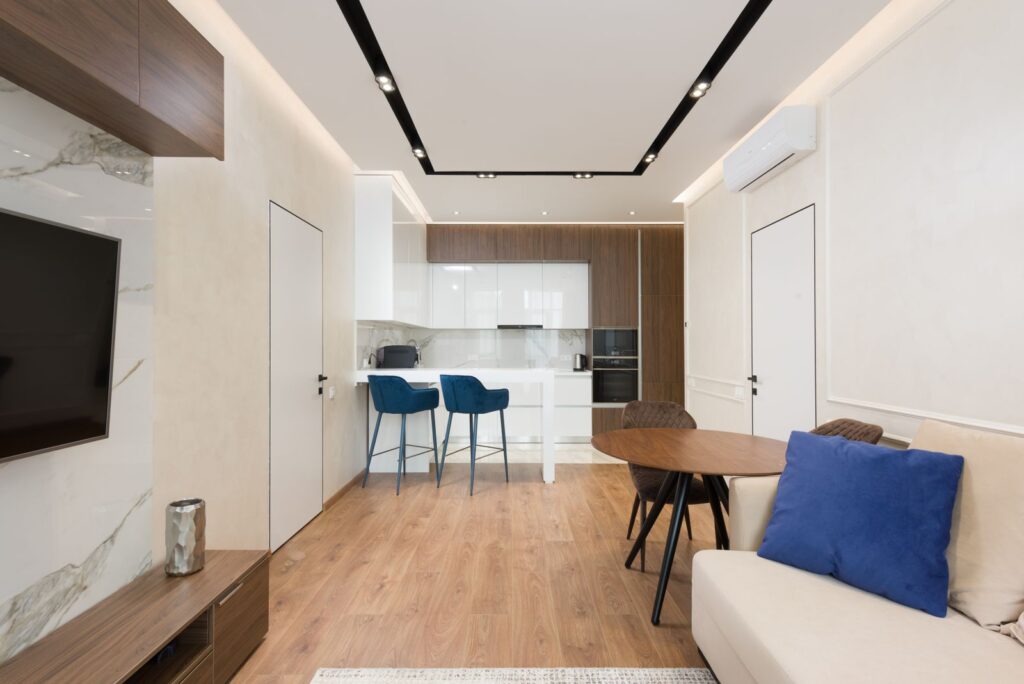
Presentation is the demand factor you can change most easily. Before the first booking, budget for one-off items: furnishing and styling, professional photos, linen, kitchen equipment and a smart lock or key box.
If your apartment needs furnishing or upgrades, Signature Prospera’s furnishing consultancy will advise you on the changes that lift your nightly rate, show you the cost against the expected return and recommend trusted suppliers. Licensed contractors carry out the work, and Signature Prospera then sets the home up for guests.
Rental Potential Checklist
Use this table to evaluate property value as a holiday home before you spend on setup.
| Check | What to look for |
|---|---|
| Sale and purchase agreement | No clause that rules out holiday home use |
| Building | Not a hotel or hotel apartment building; a developer NOC if needed |
| Permit | Eligible for a DET/DTCM permit before listing |
| Size and layout | Who it sleeps, within the permit’s maximum occupancy |
| Location, views and amenities | Why a guest would choose it, described accurately |
| Booked rates | Similar units in your building, with a low, expected and high case in writing |
| Costs | Running, per-stay, platform, management and government charges |
| Setup | Furnishing, photos and guest-ready preparation |
How Signature Prospera Assesses Your Property
Signature Prospera is a holiday home management company in Dubai and Sharjah. In a free rental assessment, we look at your apartment or villa, check the building rules and give you an honest view of whether short stays suit it. We explain the DET/DTCM permit steps and the running costs, and show you how our flat monthly fee works, with plans that have no lock-in.
For income, our pricing report compares your unit with real booked rates for similar apartments in your building and gives you a low, expected and high case in writing. There are no guaranteed returns, only transparent projections. The permit is issued in your name, and we never list a unit while its permit is still pending.
The assessment is free, with no obligation. Book your free rental assessment for your apartment or villa.
Frequently Asked Questions
How do I evaluate a property’s value as a holiday home?
Check the rules first: your sale and purchase agreement, the building type and whether a developer NOC is needed. Confirm the unit can get a DET/DTCM permit. Then compare real booked rates for similar units in your building, get a low, expected and high case in writing and subtract every cost.
Can any apartment in Dubai become a holiday home?
No. As of November 2026, holiday homes are not permitted in hotel or hotel apartment buildings, and the sale and purchase agreement must not rule out holiday home use. Every unit must also be registered and approved by DET/DTCM before it is listed.
How much will my apartment earn as a holiday home?
It depends on your unit, its building and the time of year. Signature Prospera’s pricing report uses real booked rates for similar apartments in your building and gives you a low, expected and high case in writing. There are no guaranteed returns, only transparent projections.
What government charges apply to a Dubai holiday home?
As of November 2026, DET/DTCM charges a permit fee on issue and at each yearly renewal, from AED 370 for a studio or one-bedroom unit. The Tourism Dirham is charged to guests per bedroom, per night. Exemptions announced in May 2026 may apply, so check the current position with DET/DTCM.
Sources
- Dubai Department of Economy and Tourism, Hospitality services and permits, accessed November 2026
- Dubai Department of Economy and Tourism, Holiday Homes System User Guide, accessed November 2026
- Dubai Department of Economy and Tourism, Register to operate Holiday Homes, accessed November 2026
- Dubai Department of Economy and Tourism, Renew a Holiday Homes permit, accessed November 2026
- Dubai Legislation Portal, Administrative Resolution No. (1) of 2020 Issuing the Implementing Bylaw of Decree No. (41) of 2013, accessed November 2026
- Dubai Legislation Portal, Executive Council Resolution No. (2) of 2014 Approving the Tourism Dirham Fee, accessed November 2026
- Government of Dubai Media Office, Hamdan bin Mohammed approves second, larger AED1.5 billion economic incentives package, accessed November 2026
- Government of Dubai Media Office, Dubai’s tourism industry achieves third successive record-breaking year, accessed November 2026
About the Author
Madhuri Chari is the Founder and CEO of Signature Prospera, a holiday home management company in Dubai and Sharjah. She built the company around an owner-first approach, drawing on years of work in brand strategy, client relations and operational leadership. Connect with her on LinkedIn.
This article is general information, not legal or financial advice.