
Short-term vs long-term rental in Dubai is one of the first choices you make as an owner. A long-term rental means one tenant on a tenancy contract, usually for a year. A short-term rental means a holiday home, let furnished to guests by the night under a DET/DTCM permit. The two follow different rules, earn money in different ways and need different amounts of your time.
Neither suits every owner, and a yearly tenancy can be the better fit. This guide answers the questions owners ask when comparing the two, as of November 2026.
Key Takeaways
- A tenancy is registered with Ejari under Law No. 26 of 2007. A holiday home needs a DET/DTCM permit before it is listed.
- Tenancy rent is fixed for the contract and capped at renewal. Holiday home income changes with demand and nightly rates.
- A tenancy needs little daily work. A holiday home is a daily operation.
- Holiday homes are let fully furnished and bring extra costs, such as cleaning, platform commissions and permit fees.
- A holiday home leaves room for your own stays. A tenancy does not.
The Legal Frame: Tenancy Contract or Holiday Home Permit
RERA, part of the Dubai Land Department, oversees tenancies. DET/DTCM (Dubai’s Department of Economy and Tourism) licenses holiday homes. Our guide to what property management means in Dubai covers both.
Long-Term Rental: A Tenancy Registered With Ejari
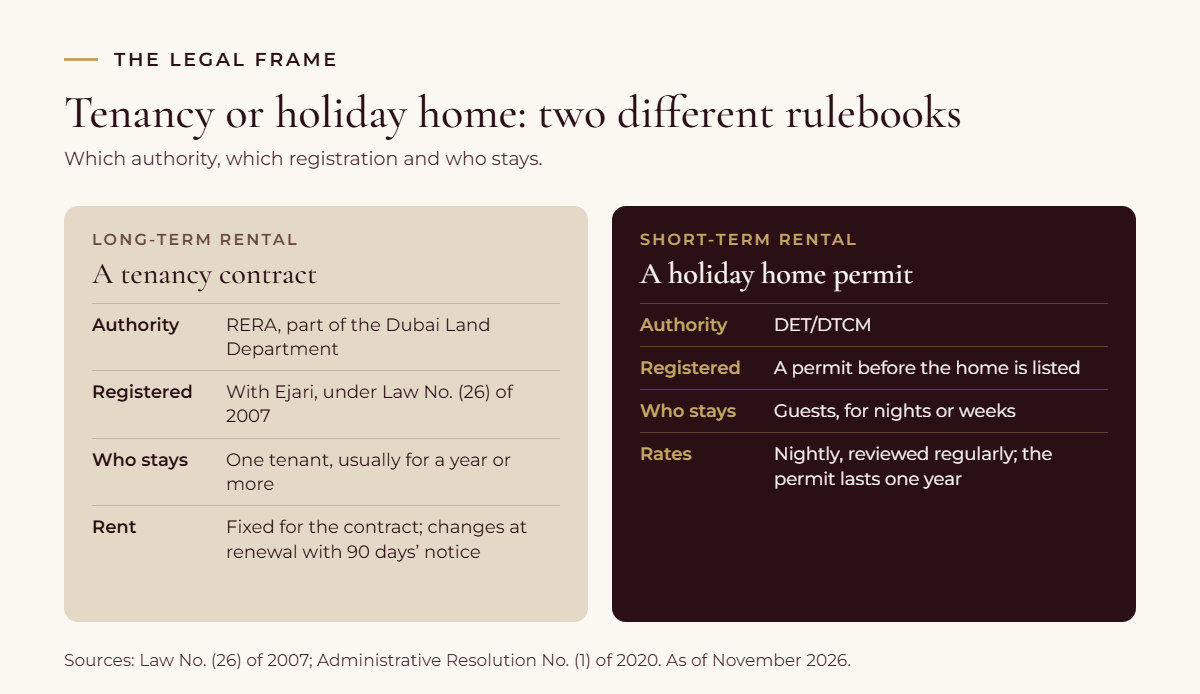
Under Law No. (26) of 2007, lease contracts must be registered with RERA, which is done through the Ejari system, and the unified tenancy contract commits the landlord to registering it.
The rent is fixed for the contract. A party that wants to change the terms at renewal, including the rent, must give notice at least 90 days before the contract ends, unless both sides agreed otherwise. Under Decree No. (43) of 2013, there is no increase if the rent is up to 10% below the average for similar units in RERA’s rental index, rising in steps to a maximum of 20% where it is more than 40% below.
Short-Term Rental: A DET/DTCM Holiday Home Permit
Every holiday home must be registered and approved by DET/DTCM before it is listed. Under Administrative Resolution No. (1) of 2020, a permit is valid for one year, the permit number must appear in every advert, and the licensee must keep guest records and hold a comprehensive insurance policy that covers damage guests may suffer. DET/DTCM’s Holiday Homes System user guide explains that renewal opens only in the 30 days before expiry.
Under the same resolution, the sale and purchase agreement must not contain a clause that rules out holiday home use. Holiday homes are not permitted in hotel or hotel apartment buildings, and a developer NOC may be needed. Check that your building or community allows short stays.
How Rental Income Behaves
A tenancy pays a fixed rent. You know the figure for the whole contract. The trade-off is that the rent stays the same in busy months too.
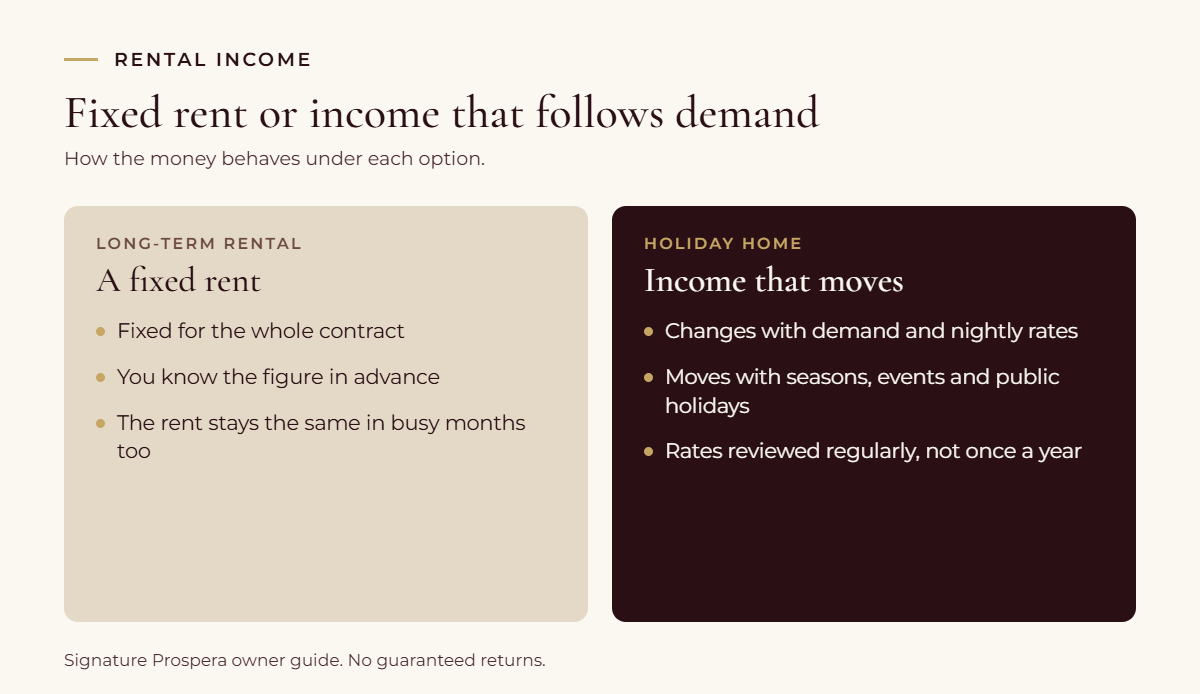
A holiday home’s income changes with demand and nightly rates. Demand for short stays in Dubai moves with the seasons, events and public holidays, so rates are reviewed regularly rather than set once a year. Busy periods can earn more, but income is less predictable from month to month, and quiet dates take closer management to fill. Our guide to evaluating your property’s rental potential shows how to judge demand, booked rates and costs.

The Work and the Furnishing
Day-to-Day Work
With a long-term tenant, the work is mostly rent collection, the tenancy contract and the odd repair, and the cycle turns about once a year.
A holiday home is a daily operation. Guests arrive and leave every few days, and the home must be ready each time. Someone has to handle listings and pricing, guest messages at any hour, guest verification and registration, check-ins, cleaning and linen, maintenance, permit renewals and Tourism Dirham records. You can do it yourself or hand it to a team, as our page on holiday home management for Dubai property owners explains, and our guide to managing your Airbnb property yourself or with a manager compares the two.
Furnishing and Setup
Long-term rentals are often let unfurnished. Holiday homes are let fully furnished and equipped, so there are one-off costs before the first booking, such as furniture, photography and the first sets of linen.
With Signature Prospera, furnishing is consultancy: our furnishing consultancy will advise you and recommend trusted suppliers, and licensed contractors carry out the work. The setup itself, turning the apartment into a guest-ready holiday home, is done by Signature Prospera.
For the day-to-day work of a short-term let, read what Airbnb management covers in Dubai.
Costs That Move With Each Option
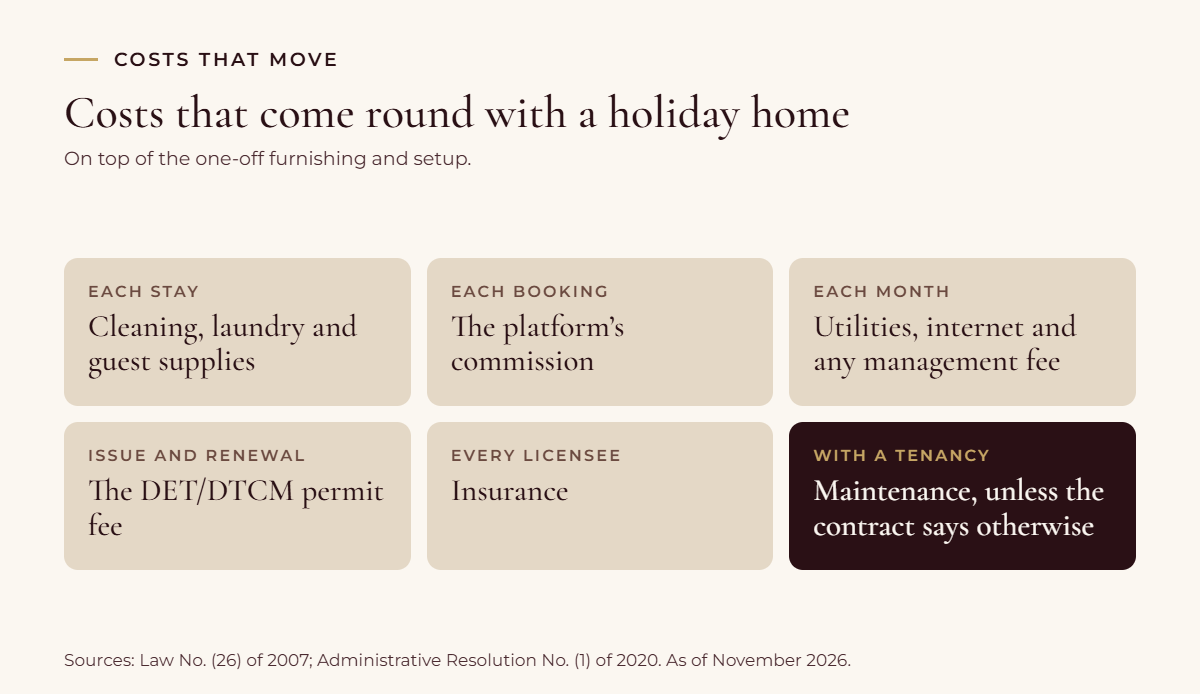
With a tenancy, the main moving cost is maintenance: under Law No. 26 of 2007, it falls to the landlord during the tenancy unless the contract says otherwise. A holiday home adds costs that come round more often:
- Cleaning, laundry and guest supplies for each stay
- The booking platform’s commission on each booking
- Utilities, internet and any management fee each month
- The DET/DTCM permit fee, on issue and at each renewal
- The insurance every licensee must hold
The Tourism Dirham is charged to guests per bedroom, per night, for example AED 20 a night for a two-bedroom apartment and AED 30 for a three-bedroom. The licensee collects it and pays it to DET/DTCM under Executive Council Resolution No. (2) of 2014. An incentives package announced on 21 May 2026 includes exemptions from Tourism Dirham collection and from holiday home permit and licence fees for establishments registered with DET/DTCM, so check the current position with DET/DTCM. Our guide to what holiday home management fees include covers each cost.
Using the Property Yourself
With a tenancy, the tenant lives in the home for the term of the contract. A holiday home leaves room for your own stays between bookings. With Signature Prospera, you block your dates with us, and in peak season you check with us first and give one week’s notice.
Short-Term vs Long-Term Rental at a Glance
| Topic | Long-term rental | Holiday home |
|---|---|---|
| Who stays | One tenant, usually for a year or more | Guests, for nights or weeks |
| Legal frame | Tenancy contract registered with Ejari | DET/DTCM holiday home permit |
| Price changes | At renewal, with 90 days’ notice, within the caps | Nightly rates reviewed regularly |
| Income | Fixed rent | Changes with demand |
| Furnishing | Often unfurnished | Fully furnished and equipped |
| Daily work | Low | High |
| Costs that move | Maintenance | Cleaning, supplies, commission, utilities, permit and insurance |
| Your own use | Not during the tenancy | Block dates between bookings |
Questions to Ask Yourself Before You Choose
Before you decide, ask yourself:
- How much time do you want to give the property?
- Do you need a fixed figure you can plan around?
- Does your building allow short stays, and is the unit a residential apartment or villa?
- Are you ready to furnish fully and keep the home guest-ready?
- Will you want to stay there yourself?
- If you live abroad, who will handle check-ins, repairs and renewals?
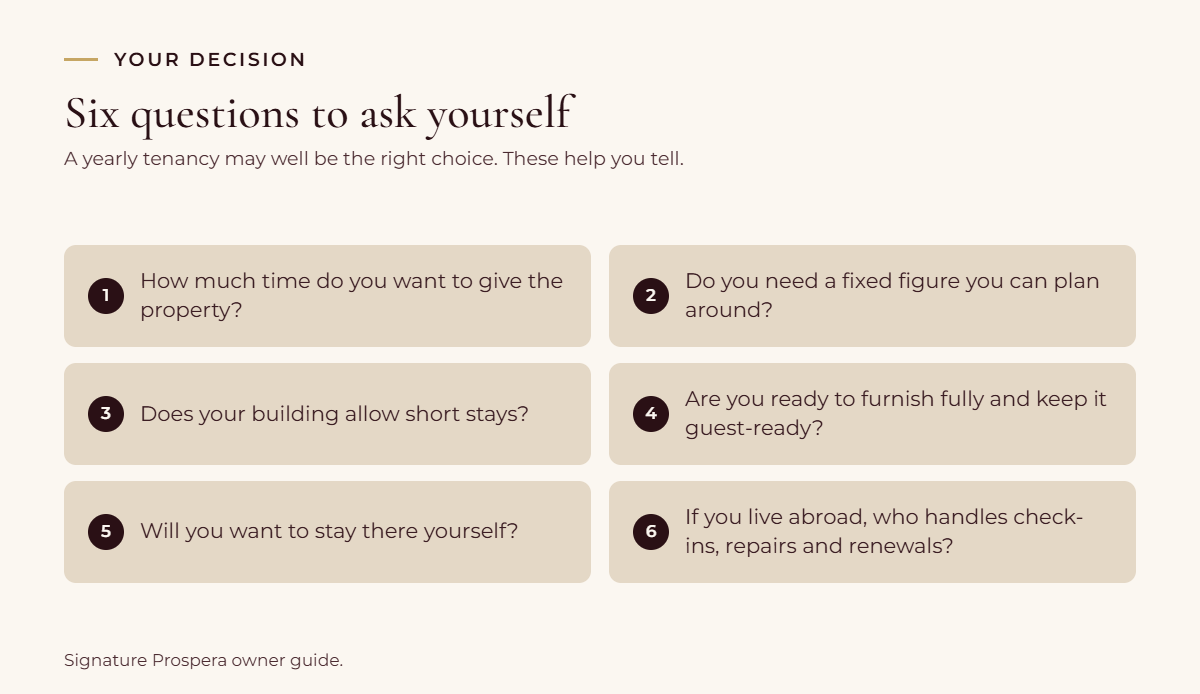
If you want a steady arrangement with little involvement, a yearly tenancy may well be the right choice. If you are ready for more involvement, a holiday home is worth a closer look.
How Signature Prospera Helps You Decide
Signature Prospera provides holiday homes operations management in Dubai and Sharjah. We visit your property, check the building rules and tell you honestly whether short stays suit it. We also compare your unit with real booked rates for similar apartments in your building and give you a low, expected and high case in writing. There are no guaranteed returns.
If you go ahead, the holiday home permit is issued in your name and we prepare the paperwork with you. Rental income goes to your bank account after every booking, and our one flat monthly fee, set by property type, is invoiced separately, with no revenue share. Plans are quarterly, six-month or annual, with no lock-in. To start, book a free rental assessment.
Frequently Asked Questions
Is short-term or long-term rental better for my Dubai property?
It depends on the location, the building rules, your income goals and how involved you want to be. A yearly tenancy gives a fixed rent and little daily work. A holiday home’s income changes with demand, and it needs daily management, a DET/DTCM permit and a building that allows short stays.
Do I need a permit to rent my apartment short term in Dubai?
Yes. As of November 2026, every holiday home must be registered and approved by DET/DTCM before it is listed. A permit is valid for one year, and renewal opens only in the 30 days before it expires. Holiday homes are not permitted in hotel or hotel apartment buildings.
How much can I raise the rent on a yearly tenancy?
Under Decree No. 43 of 2013, there is no increase if the rent is up to 10% below the average for similar units in RERA’s rental index, rising in steps to a maximum of 20% if it is more than 40% below. Notice of any change is due at least 90 days before the contract ends, unless both sides agreed otherwise.
Can I still use my apartment if it is a holiday home?
Yes. With Signature Prospera, you block your dates with us. In peak season, check with us first about existing bookings and give one week’s notice. Your personal stays carry no management fee, only a cleaning fee.
Sources
- Dubai Legislation Portal, Law No. (26) of 2007 Regulating the Relationship between Landlords and Tenants in the Emirate of Dubai, accessed November 2026
- Dubai Legislation Portal, Decree No. (43) of 2013 Determining Rent Increase for Real Property in the Emirate of Dubai, accessed November 2026
- Dubai Department of Economy and Tourism, Hospitality services and permits, accessed November 2026
- Dubai Department of Economy and Tourism, Holiday Homes System User Guide, accessed November 2026
- Dubai Department of Economy and Tourism, Renew a Holiday Homes permit, accessed November 2026
- Dubai Legislation Portal, Administrative Resolution No. (1) of 2020 Issuing the Implementing Bylaw of Decree No. (41) of 2013, accessed November 2026
- Dubai Legislation Portal, Executive Council Resolution No. (2) of 2014 Approving the Tourism Dirham Fee, accessed November 2026
- Government of Dubai Media Office, Hamdan bin Mohammed approves second, larger AED1.5 billion economic incentives package, accessed November 2026
- Dubai Land Department, Ejari unified tenancy contract, accessed November 2026
- Dubai Land Department, Smart Rental Index announcement, accessed November 2026
About the Author
Madhuri Chari is the Founder and CEO of Signature Prospera, which provides holiday homes operations management in Dubai and Sharjah. She built the company around an owner-first approach, drawing on years of work in brand strategy, client relations and operational leadership. Connect with her on LinkedIn.
This article is general information, not legal or financial advice.