
Starting an Airbnb business in Dubai is straightforward on paper. You register, furnish, list and welcome guests. In practice, the owners who succeed treat it as a small hospitality business from day one, with a clear structure, a budget for every stay and someone ready to answer guests at any hour.
This guide sets out the structure to choose, the rules to follow, the costs to plan and how long each step takes before your first guest arrives.
Key Takeaways
- Owners can register up to eight holiday home units themselves; larger operations need a company with a holiday homes trade licence.
- Check the building NOC first, because some buildings do not allow holiday homes.
- DET lists a one-business-day service time for registration once documents are ready.
- Budget for setup, per-stay costs, monthly running costs and a reserve, as well as fees.
- The daily work includes pricing, guest messages, registration, cleaning and the Tourism Dirham.
Step 1: choose your structure
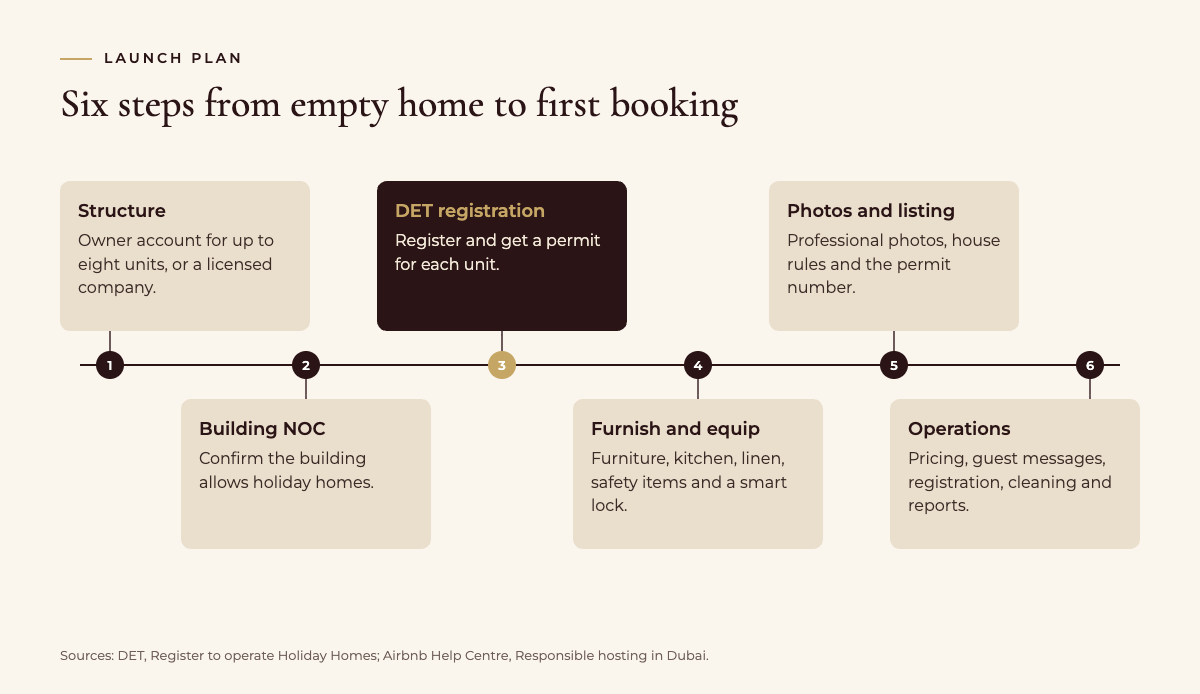
If you own one or a few homes, you can register as a homeowner on DET’s Holiday Homes system and run up to eight units. If you plan to grow beyond that, or to run homes for other owners, you need a company with a trade licence that covers holiday home rental. Our guide to the holiday home licence in Dubai explains the difference between the unit permit and the trade licence.
Step 2: check the building
Ask the developer, building management or owners’ association whether holiday homes are allowed and what the NOC requires. This can take longer than any other step, so start it first.
Step 3: register and get the permit
Create your account on the Holiday Homes system, add the unit, upload your documents and choose Standard or Deluxe. DET’s service page lists registration charges totalling AED 1,520 and a service time of one business day.
Step 4: furnish and equip
Furnish for the guests you expect. Tourists want comfort and good photos; monthly guests want a desk, storage and a working kitchen. Add a smoke detector, fire extinguisher, fire blanket and first aid kit, and fit a smart lock or key box for flexible check-in. Allow several weeks for furniture delivery and installation.
Step 5: photos and listing
Professional photos are one of the most useful early investments. Write a clear description, set house rules that include Dubai’s midnight visitor rule, and add your permit number to the listing. Our guide to Airbnb listing management covers the details.
Step 6: set up operations
Before the first booking, decide who will price the nights, answer messages, collect ID, register guests, arrange cleaning, restock linen and pay the Tourism Dirham each month. Dubai’s rules expect a 24/7 contact for guests, so the phone must be answered at night as well as during the day.

What it costs
There is no single figure, because costs depend on the size, area and standard of the home. Plan for these lines:
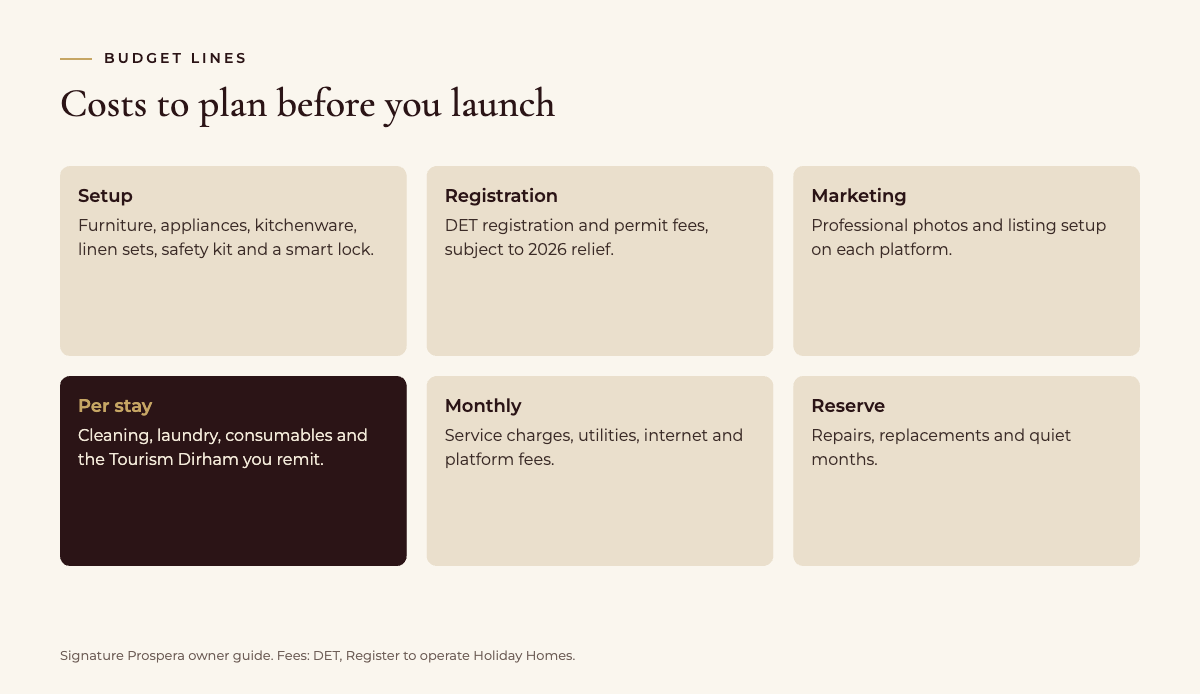
- Setup: furniture, appliances, kitchenware, two or three sets of linen per bed, safety equipment and access hardware.
- Per stay: cleaning, laundry, toiletries and consumables, and the Tourism Dirham you collect and pay to DET.
- Monthly: service charges, utilities, internet and platform fees.
- Reserve: repairs, replacements and a buffer for quiet months.
VAT and corporate tax can apply to some hosts depending on income and structure. Take advice from a UAE tax adviser before your first full year.
What it can earn
Returns vary widely by area, home and season. As one reference point, the First Class Short-Term Rental Index found that one-bedroom short-term rentals produced an average gross yield of 7.2% in the second quarter of 2026, against 5.2% for long-term rentals, even in a weak quarter. Gross yield is before running costs, so build your own model on realistic quiet months.
Run it yourself or hand it over
Many owners start alone and then bring in help once they see the hours involved. Our comparison of managing your Dubai Airbnb yourself or with a manager sets out the work each route takes. Signature Prospera runs Airbnb management in Dubai for one fixed fee by property type, with rental income paid to your bank account.
More Airbnb Management Guides
- What Is Airbnb Management? A Guide for Dubai Owners
- Airbnb Guest Management in Dubai, From Enquiry to Checkout
- Airbnb Listing Management: Keeping a Dubai Listing Booked
- Airbnb Revenue Management in Dubai: Rates, Stays, Seasons
- Airbnb Co-Hosting in Dubai: How Host Management Works
- Managing a Dubai Airbnb From Abroad: What Owners Need
- Airbnb Villa Management in Dubai: What Changes for a Villa
- Airbnb Management for Dubai Investors With Several Units
- Airbnb Check-In in Dubai: Keys, Access Cards, Smart Locks
- Airbnb Management Software: Tools Behind a Dubai Listing
- Airbnb Rules in Dubai: What Hosts Must Do in 2026
- Airbnb Pricing in Dubai: A Month-by-Month Guide for Holiday Homes
- Best Area for Airbnb in Dubai: An Owner’s Area Guide
- Airbnb in Dubai Marina: What Holiday Home Owners Should Know
Frequently Asked Questions
Is it legal to start an Airbnb business in Dubai?
Yes, as long as each home holds a DET holiday home permit and the building allows holiday homes. Companies and larger portfolios also need a trade licence for holiday home rental.
How long does it take to start an Airbnb in Dubai?
DET lists a one-business-day service time for registration once documents are ready. The building NOC and furnishing usually take longer, so plan for several weeks.
How many Airbnb units can I run without a company?
Homeowners can register up to eight holiday home units themselves. Beyond that, you need a licensed operator structure.
What costs should I budget for?
Budget for setup, registration, photos, per-stay cleaning and laundry, monthly running costs and a repair reserve. Fees depend on the home, area and standard.
Do I need to pay tax on Airbnb income in Dubai?
VAT and corporate tax can apply to some hosts depending on income and structure. Speak to a UAE tax adviser before your first full year.
Sources
- Dubai Department of Economy and Tourism: Register to operate Holiday Homes
- Airbnb Help Centre: Responsible hosting in Dubai
- Nukta: Dubai holiday rental revenue falls 46.5%, but returns beat long-term rentals
- Signature Prospera: How our fixed fee works
About the Author
Madhuri Chari is the Founder and CEO of Signature Prospera, which provides holiday homes operations management in Dubai and across the UAE. She built the company around an owner-first approach, drawing on years of work in brand strategy, client relations and operational leadership. Connect with her on LinkedIn.
This article is general information, not legal or financial advice.